
Kirchenruine mit Figuren und Herkulesstandbild — History & Facts
What if beauty was never meant to be finished? This thought lingers, urging us to explore the delicate balance between ruin and renewal in art’s eternal embrace. Look to the left at the crumbling arches, where soft, muted earth tones evoke the weight of history. The ruins rise majestically, yet they are intertwined with the vitality of human figures, almost ghostly in their presence. Notice how the light spills across the scene, illuminating the statue of Hercules, imbuing it with a heroic glow that contrasts sharply with the decay surrounding it.
The skillful interplay of light and shadow invites the eye to wander, uncovering layers of meaning in the juxtaposition of the ancient and the living. Amidst the ruins, there’s a palpable tension between the past and the present, captured in the figures’ gestures—some are contemplative, while others seem to embody a sense of urgency. This duality reveals a deeper narrative: the struggle to find beauty amidst decay, and the awakening of life from the remnants of what once was. Each detail, from the statuary’s grandeur to the figures’ diverse expressions, resonates with themes of resilience and rebirth. Leonardo Coccorante painted this work in the late 18th century, a time when the fascination with ruins and the sublime was gaining prominence.
Living in Italy, he was influenced by the Neoclassical movement, which emphasized a return to classical ideals and forms. The artwork reflects not only Coccorante’s mastery of landscape but also a cultural moment where the echoes of antiquity inspired a renewed exploration of beauty and meaning in art.
More Artworks by Leonardo Coccorante
Browse all →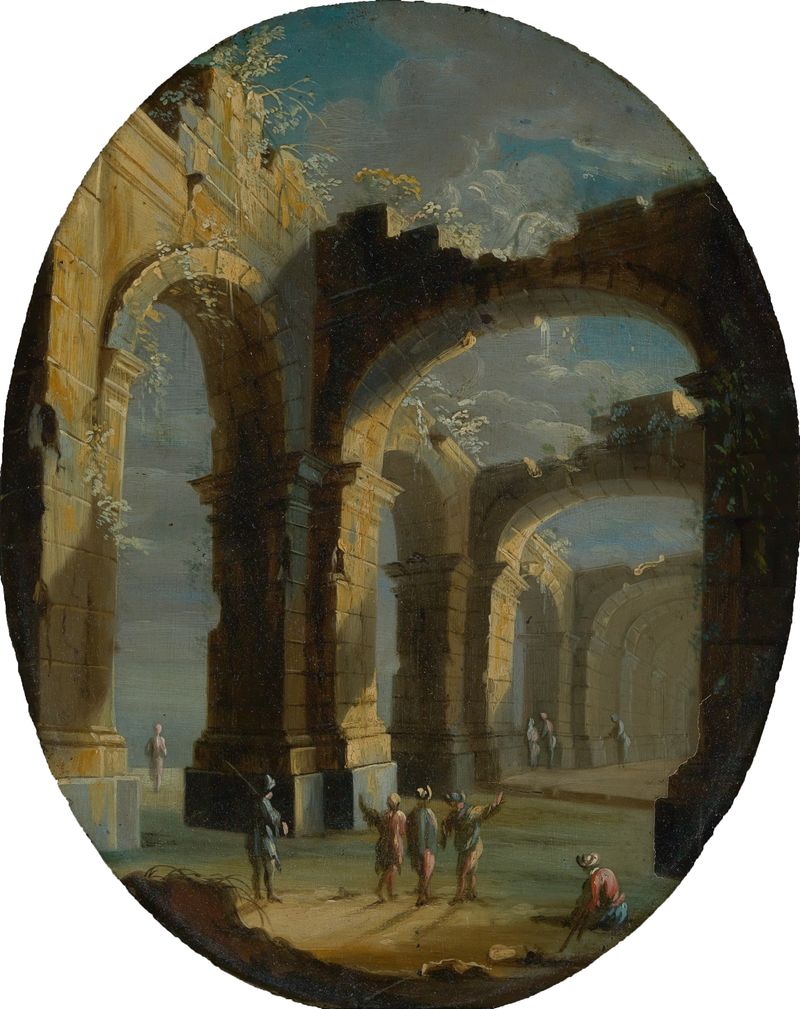


More Architecture Art
Browse all →
The statue of Liberty
Frédéric Auguste Bartholdi

View of Houses in Delft, Known as ‘The Little Street’
Johannes Vermeer

View of Houses in Delft, Known as ‘The Little Street’
Johannes Vermeer

The Cathedral in Rouen. The portal, Grey Weather
Claude Monet

The yellow house
Vincent van Gogh

The Church in Auvers-sur-Oise, View from the Chevet
Vincent van Gogh