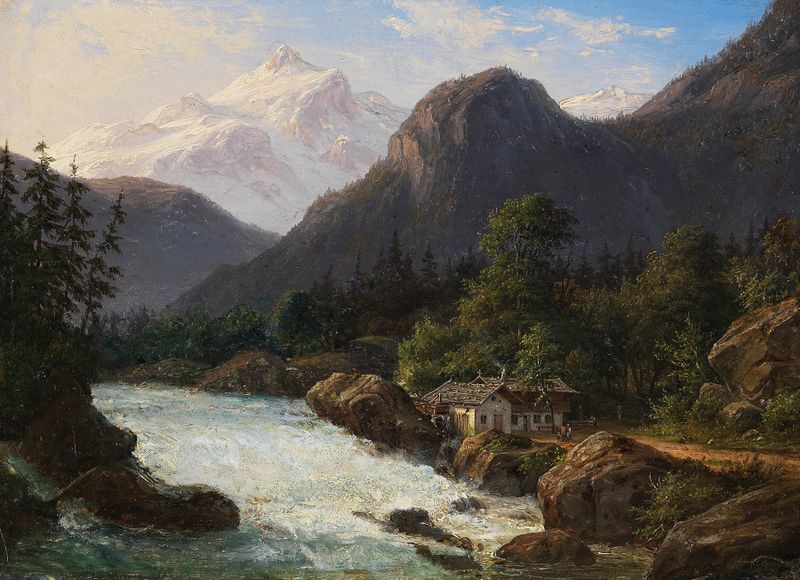
Klippelandskab. Djupadal i Bleking — History & Facts
What if silence could speak through light? This poignant question echoes through the layers of Klippelandskab. Djupadal i Bleking, inviting us to contemplate the quiet melancholy that permeates the landscape. Look closely at the muted hues that dominate the canvas, where soft greens and grays intertwine like whispered thoughts. The horizon beckons your gaze, drawing you to the subtle gradients of sky meeting earth.
Notice how the light gently bathes the rocky outcrops, casting long shadows that stretch towards the foreground, creating a sense of depth and solitude. The careful brushwork captures the texture of the land, every stroke reminiscent of a heartbeat in this serene yet somber scene. Amidst the natural beauty, a profound stillness resonates. The sparse details of the foreground contrast with the expansive sky, evoking a sense of isolation.
This tension between the vibrant earth and the vast emptiness above speaks to a deeper longing, as if the landscape itself mourns what is lost, yet remains steadfast in its existence. The play of light serves as a metaphorical language, revealing the emotional currents beneath the surface, inviting introspection from the viewer. In 1855, Frederik Christian Jakobsen Kiærskou painted this work during a period marked by significant shifts in both his personal life and the broader art scene. Living in Denmark, surrounded by the romantic landscapes of his homeland, he was influenced by the burgeoning movement of realism that sought to depict nature with authenticity.
This reflective piece captures his artistic exploration at a time when artists were increasingly drawn to the interplay of light and shadow, seeking to evoke emotion through their depictions of the world.