
Kloster Sant´Agnese bei Rom — History & Facts
In the quiet aftermath of loss, how can one encapsulate grief onto a canvas? The artful depictions of memory can echo the deepest sorrows of the heart. Look to the left where the ancient architecture rises solemnly against the backdrop of a soft, muted sky. The cloister's arches frame the scene, inviting the viewer to step into a world that feels both still and reverent. Notice how the delicate interplay of light and shadow caresses the stone, evoking a sense of timelessness, while the muted palette of earthy tones whispers of nostalgia and remembrance. As you explore the details, notice the faint brushstrokes that seem to linger, embodying the essence of absence.
The subtle outlines of figures, almost ghostly in their presence, speak of lives once lived within these walls, creating an emotional tension between the beauty of the moment captured and the weight of what has been lost. Each element contributes to a poignant narrative, hinting at stories of hope and sorrow intertwined, revealing the duality of existence within the tranquility of the scene. Friedrich Olivier painted this work in 1820 while living in Rome, a city rich in history and artistic legacy. At this time, the Romantic movement was flourishing, emphasizing the emotional depth of human experiences.
Olivier’s personal journey, intertwined with the grand narratives of art and loss, influenced his delicate portrayal of architecture, infusing it with a palpable sense of longing and reflection, encapsulating the essence of a grief-born memory.
More Artworks by Friedrich Olivier
Browse all →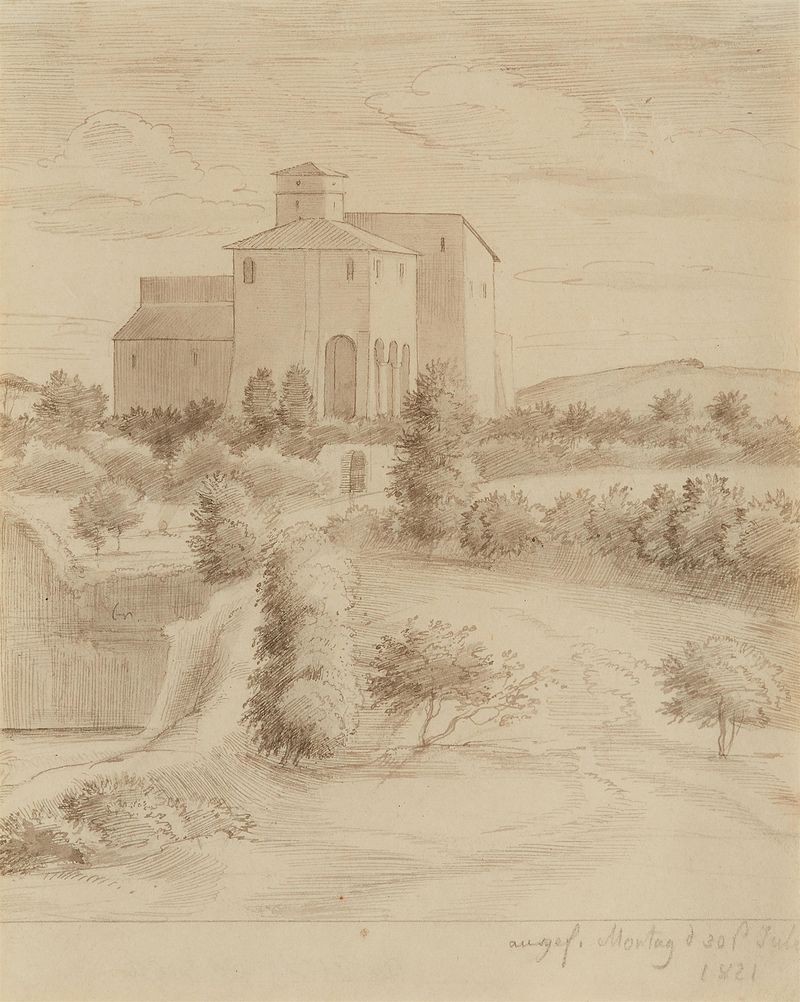
More Architecture Art
Browse all →
The statue of Liberty
Frédéric Auguste Bartholdi

View of Houses in Delft, Known as ‘The Little Street’
Johannes Vermeer

View of Houses in Delft, Known as ‘The Little Street’
Johannes Vermeer

The Cathedral in Rouen. The portal, Grey Weather
Claude Monet

The yellow house
Vincent van Gogh

The Church in Auvers-sur-Oise, View from the Chevet
Vincent van Gogh