
Kościół św. Wojciecha — History & Facts
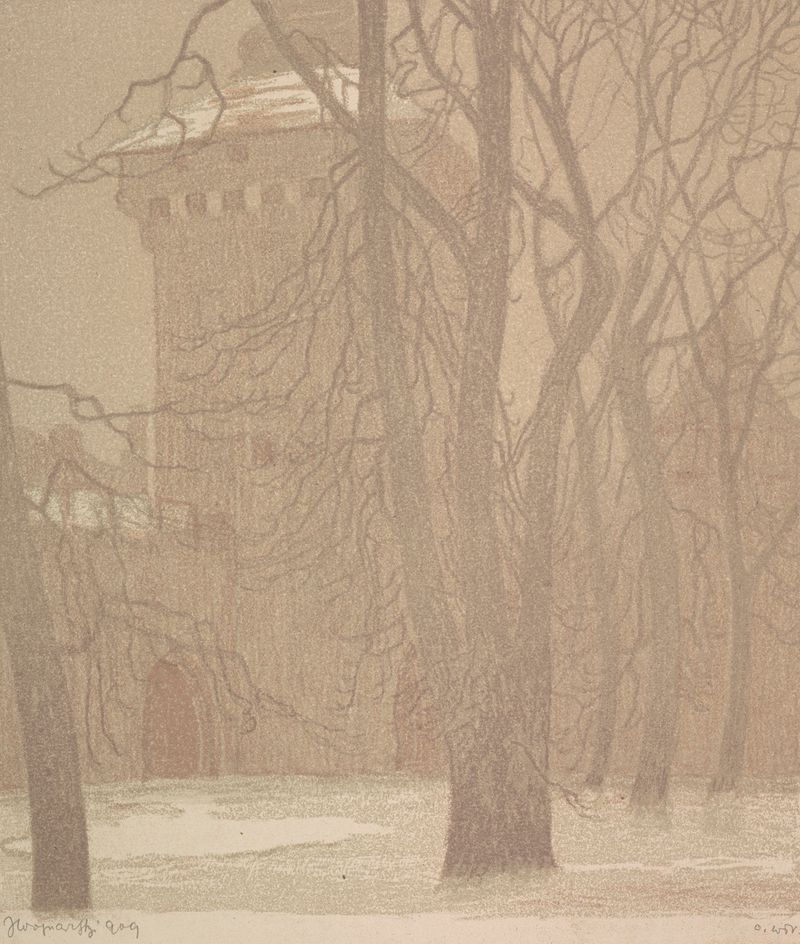
In the interplay of light and shadow, movement whispers through stillness, inviting us to ponder what lies beneath the surface of our everyday lives. Look to the center of the canvas, where the majestic Kościół św. Wojciecha stands proudly against a backdrop of shifting skies. The intricate details of the church's architecture draw the eye, with its pointed spires and ornate embellishments reaching toward the heavens.
Notice how the artist expertly employs a palette of deep blues and soft grays, mirroring the delicate dance of clouds, as they hint at an impending storm — a dynamic contrast between the solidity of the structure and the ethereal quality of the sky. Delve deeper into the painting, and you’ll uncover subtle tensions that provoke thought. The church, a symbol of permanence, contrasts sharply with the ephemeral nature of the weather that surrounds it. The brushstrokes convey a sense of wind and movement, suggesting that even the most steadfast buildings are subject to change.
Perhaps it represents the interplay between tradition and modernity, a reflection of societal shifts in the early 20th century. In 1911, Jan Wojnarski was immersed in a rapidly evolving art scene in Poland, grappling with themes of identity and heritage. During this period, he sought to capture not only the physical beauty of architecture but also the fleeting moments that surround it, embodying a transition where history and the present converge. This painting serves as a testament to his exploration of movement within the stillness of his painted world.
More Artworks by Jan Wojnarski
Browse all →
More Architecture Art
Browse all →
The statue of Liberty
Frédéric Auguste Bartholdi

View of Houses in Delft, Known as ‘The Little Street’
Johannes Vermeer

View of Houses in Delft, Known as ‘The Little Street’
Johannes Vermeer

The Cathedral in Rouen. The portal, Grey Weather
Claude Monet

The yellow house
Vincent van Gogh

The Church in Auvers-sur-Oise, View from the Chevet
Vincent van Gogh