Krajina od Vinného — History & Facts
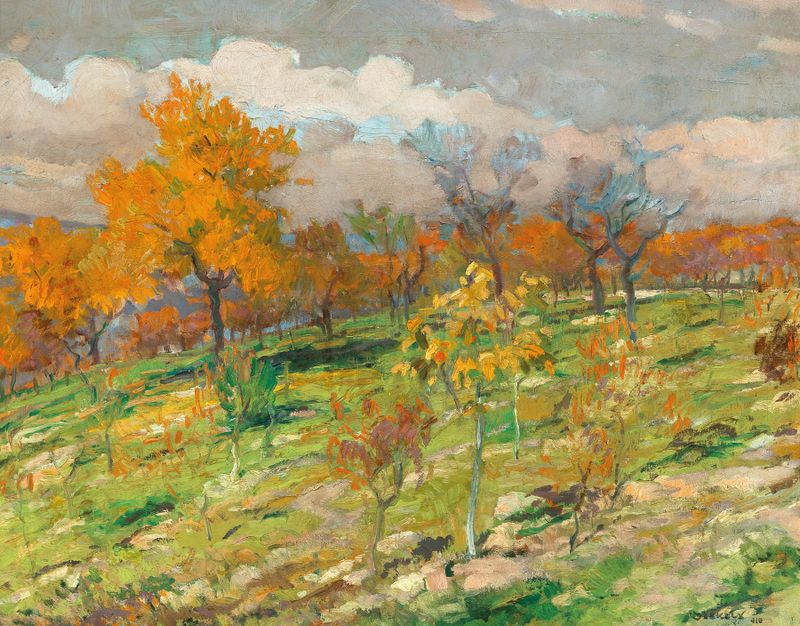
Could beauty survive in a century of chaos? In Krajina od Vinného, the answer unfolds with a serene yet poignant grace. Look to the horizon, where rolling hills embrace the sky, their lush greenery punctuated by the delicate strokes of sunlight. The artist employs a palette of vibrant greens and subtle blues, inviting the viewer into a world that feels both alive and contemplative. Notice how the undulating contours of the landscape draw your eye toward distant vineyards, their orderly rows suggesting both cultivation and care, a contrast to the tumultuous history that surrounded their creation. Within this tranquil scene lies an underlying tension; the beauty of nature juxtaposes the fragility of existence.
The gentle interplay of light and shadow evokes a sense of transience, while the scattered clouds seem to whisper of the storms that had passed and those yet to come. Each brushstroke carries the weight of unspoken stories, hinting at resilience amid adversity and the enduring spirit of the earth despite human turmoil. André de Székély painted this work in 1902, during a period marked by significant change in Eastern Europe. As an artist influenced by the growing avant-garde movements, he sought to capture the essence of his homeland while navigating personal and societal shifts.
Amidst a world on the brink of upheaval, Krajina od Vinného stands as a testament to the human capacity for finding beauty—even in the shadow of chaos.