Küstenlandschaft im Abendrot — History & Facts
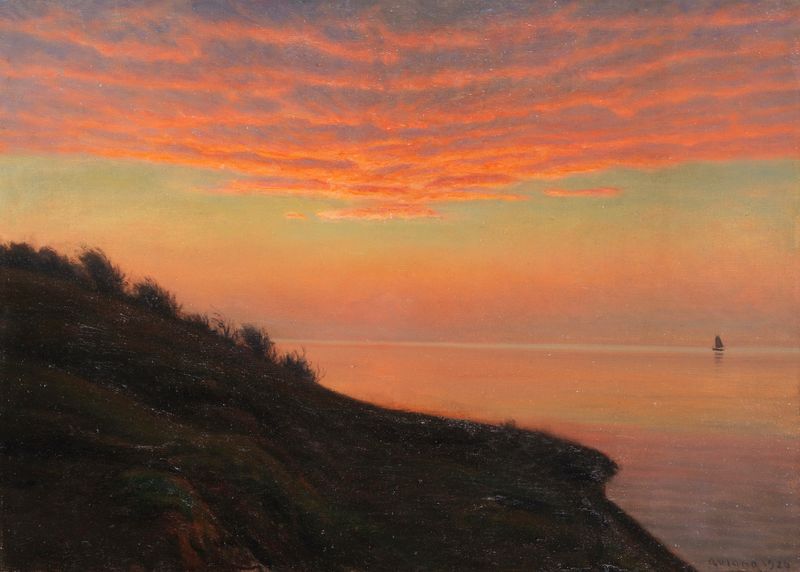
Is this a mirror — or a memory? The interplay of light and shadow in Küstenlandschaft im Abendrot evokes the essence of fleeting moments, capturing a legacy that lingers just beyond reach. First, look to the horizon where the fiery reds and oranges of twilight bleed seamlessly into the serene blues of the sea. The stark contrast draws your attention, inviting you to explore the gradient of colors that echo the day's end. Notice how the brushstrokes are both soft and deliberate, creating a textured surface that mimics the ebb and flow of the water.
The luminous sky reflects upon the waves, suggesting a dialogue between land and sea, past and present. Delve deeper into the painting and you might sense the emotional tension in the solitude of the coastal landscape. The absence of figures amplifies a sense of yearning; it prompts questions about personal histories and the passage of time. The distant cliffs stand as silent witnesses to countless sunsets, while the vibrant colors evoke nostalgia, implying that every ending holds the potential for new beginnings.
Each element intertwines to form a visual legacy, a reminder of the beauty found in transience. Created between 1900 and 1920, this work by Wang reflects a period of significant transition in the world of art, marked by movements such as Impressionism and early Modernism. Living in Norway, he drew inspiration from the landscape around him, capturing the mystique of the coastal views that defined his heritage. As Europe grappled with change and upheaval, his representation of nature offered a refuge, grounding viewers in the eternal cycle of day and night.