
La tour Eiffel et le Champ-de-Mars — History & Facts
When did color learn to lie? In La tour Eiffel et le Champ-de-Mars, hues intertwine with truth and illusion, bending the viewer's perception of reality. Look to the foreground where the vibrant greens of the Champ-de-Mars meet the cool grays of the Eiffel Tower's iron structure. The intricate lattice of the tower draws the eye upwards, an engineering marvel rendered in delicate brushwork. Notice how the light dances across the surface, illuminating the foliage and creating a shimmering quality in the sky, suggesting a fleeting moment in time that invites contemplation. Hidden within the landscape is a dialogue between nature and the monumental.
The soft, organic forms of the trees contrast sharply with the rigid, geometric lines of the tower, embodying the tension between the human-made and the natural world. The reflections in the shimmering puddles beneath the tower hint at a deeper narrative, drawing the viewer to consider how perceptions can be distorted, just like the colors themselves that seem to rise and fall with the light. During the summer of 1889, Delance captured this scene on the Champ-de-Mars in Paris, shortly after the Eiffel Tower was completed for the Exposition Universelle. This was a time when France was celebrating its innovation and industrial prowess, while the art world was in the throes of Impressionism.
The artist, influenced by the vibrant atmosphere of Paris, sought to reflect both the awe of modernity and the enduring beauty of nature in this composition.
More Artworks by Paul Louis Delance
Browse all →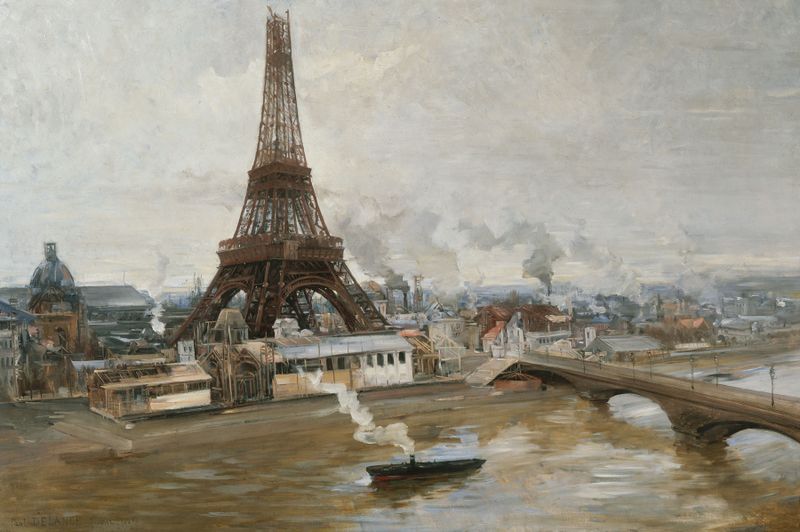
More Architecture Art
Browse all →
The statue of Liberty
Frédéric Auguste Bartholdi

View of Houses in Delft, Known as ‘The Little Street’
Johannes Vermeer

View of Houses in Delft, Known as ‘The Little Street’
Johannes Vermeer

The Cathedral in Rouen. The portal, Grey Weather
Claude Monet

The yellow house
Vincent van Gogh

The Church in Auvers-sur-Oise, View from the Chevet
Vincent van Gogh