
La Voûte du quai de Gesvres — History & Facts
In the realm of art, the tumult of life converges with the serene beauty of faith, creating a resonance that echoes through time. Each stroke tells a story, intertwining the tangible and the transcendental, inviting us to delve deeper into the artist's vision. Look closely at the intricate details of the archway in La Voûte du quai de Gesvres. The composition draws your eye upward, where the elegantly curved ceiling meets the cool, muted light filtering in from above.
Notice how Régnier employs a warm palette of ochres and browns, lending an almost sacred ambiance to the scene. The play of shadows along the stonework enhances depth, transforming the ordinary passageway into a hallowed corridor that speaks of journeys, both physical and spiritual. Beyond the surface, the interplay of light and shadow creates an emotional tension that mirrors the uncertainty of faith. The archway, a symbol of passage, evokes the transition between the earthly and the divine.
Small inscriptions along the stone surface hint at stories untold, while the almost ethereal glow above seems to beckon, suggesting hope and the search for enlightenment amidst life’s chaos. Each element invites reflection on the fragility of belief and the beauty found within it. In 1815, Régnier painted this work amidst a shifting cultural landscape in France, a time when the nation was grappling with the aftermath of the Napoleonic Wars. Artists were beginning to explore deeper psychological and emotional realms, moving away from the neoclassical rigor of the past.
This period of introspection and change greatly influenced the artist, marking a pivotal moment in his exploration of faith and human experience within his art.
More Artworks by Auguste Jacques Régnier
Browse all →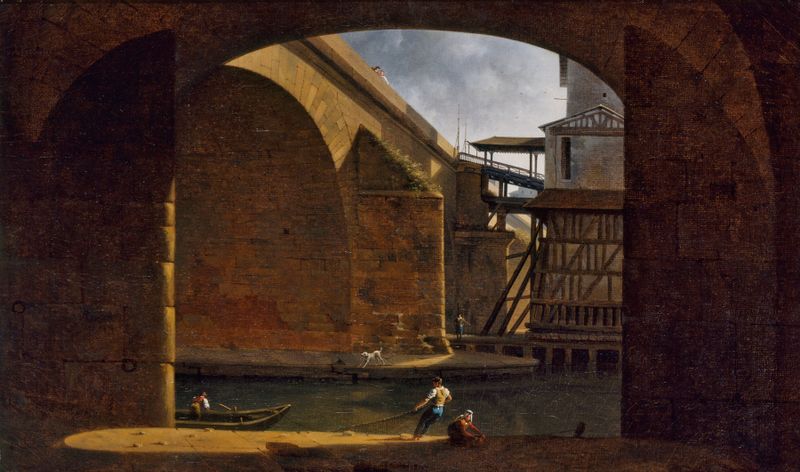
More Architecture Art
Browse all →
The statue of Liberty
Frédéric Auguste Bartholdi

View of Houses in Delft, Known as ‘The Little Street’
Johannes Vermeer

View of Houses in Delft, Known as ‘The Little Street’
Johannes Vermeer

The Cathedral in Rouen. The portal, Grey Weather
Claude Monet

The yellow house
Vincent van Gogh

The Church in Auvers-sur-Oise, View from the Chevet
Vincent van Gogh