Labourage dans le Vaucluse — History & Facts
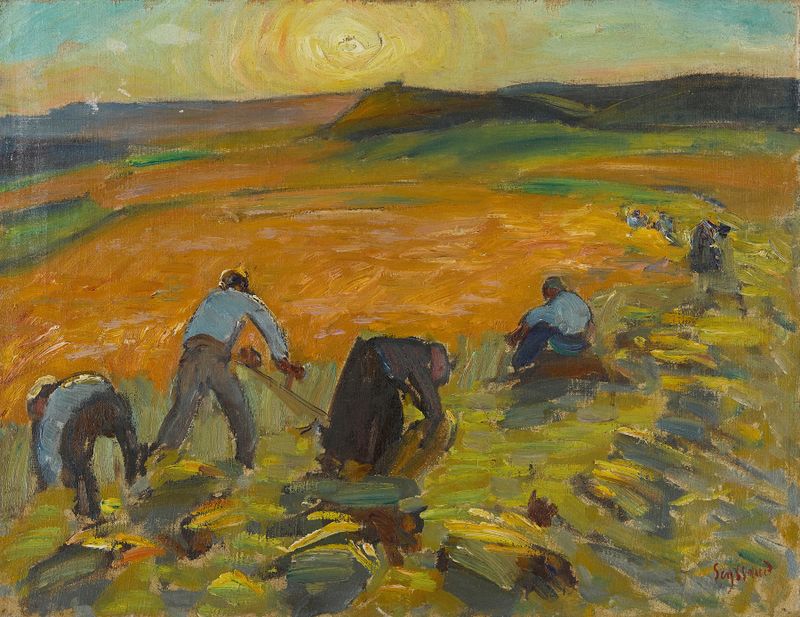
In the silent spaces of our lives, solitude often finds its expression through the gentle strokes of a master’s hand. Look to the center where the landscape stretches, the horizon a delicate line of greens and golds. The sun-drenched fields speak of labor, but the lush hues also whisper of stillness. Notice how the soft brushwork creates a rhythm that contrasts with the sharp, defined edges of the laborers’ tools, emphasizing the toil against nature’s embrace.
The palette invites you to breathe in the warmth of the earth while the figures, though engaged in their work, appear almost like shadows, retreating into the vastness around them. There’s a poignant tension here—while the characters labor, they seem isolated in their tasks, their forms blending into the landscape. The expansive sky overhead looms large and empty, amplifying a sense of loneliness amidst the busyness of life. The juxtaposition of vibrant fields against the subdued figures suggests that even in collective labor, there can be profound solitude.
A sense of yearning drifts through the paint, an echo of the human condition. Seyssaud painted this piece during a time of personal introspection, likely in the early 20th century, when he was deeply immersed in the Post-Impressionist movement. Living in the south of France, he embraced the art scene’s shift towards capturing emotional resonance in landscapes. This work reflects both his artistic evolution and the universal themes of solitude within the vibrancy of rural life, marking a moment of introspection in an ever-changing world.