Moisson au soleil couchant — History & Facts
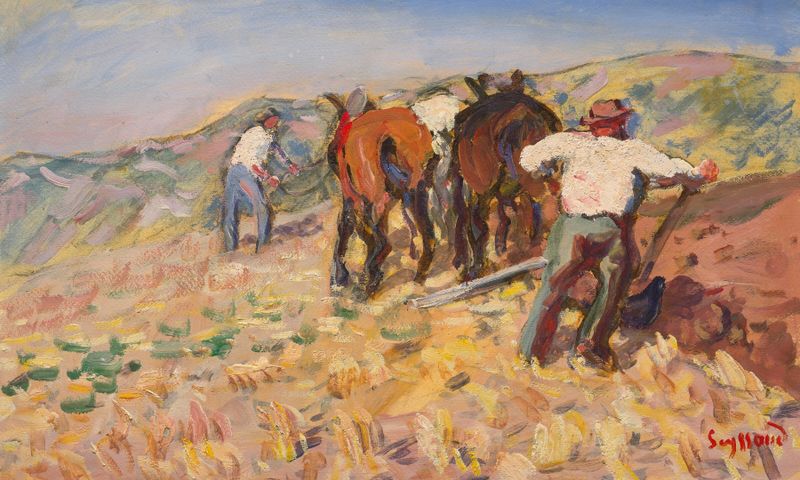
Can paint confess what words never could? In Moisson au soleil couchant, the twilight whispers of a fading day intermingle with the golden hues of a harvest, evoking emotions tied to the passage of time and the decay inherent in nature’s cycle. Look to the bottom left, where the workers’ silhouettes emerge against the backdrop of vibrant yellows and earthy oranges. The brushstrokes are both bold and tender, capturing the motion of their labor while the sun sinks low on the horizon. Notice how the light cascades over the fields, creating a glowing aura that envelops the scene, simultaneously highlighting the toil and beauty of the moment.
The composition draws the eye upward, where the sky transitions into a rich, deep blue, suggesting the inevitable encroachment of night. Beneath this tranquil harvest scene lies a poignant tension. The fading light symbolizes not just the end of the day but also the fragility of life and the inevitability of change. The workers’ posture, a mix of exhaustion and satisfaction, hints at the duality of labor—its rewards and its burdens.
There’s an undercurrent of melancholy, a reminder of what must eventually decay, as life gives way to the darkness of night. In 1927, Seyssaud found himself living in the vibrant art scene of post-war France, where traditional forms were evolving into modern expressions. This was a period marked by a renewed interest in capturing the essence of everyday life, set against the backdrop of a world still healing from conflict. Seyssaud, with his unique technique, sought to immortalize these fleeting moments, as the beauty of the harvest stood in stark contrast to the shadows of uncertainty that loomed over society.