Landscape with Cattle — History & Facts
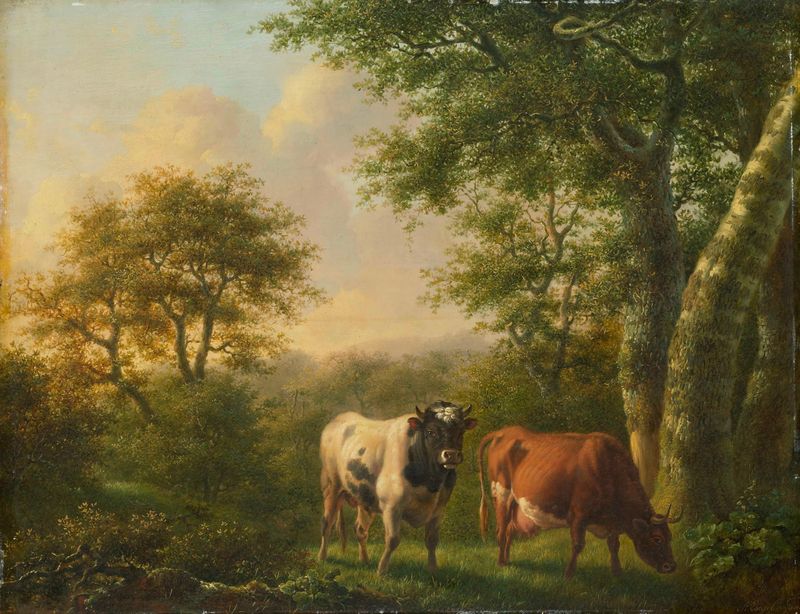
Could beauty survive in a century of chaos? In Landscape with Cattle, the artist navigates a world defined by solitude and stillness, inviting viewers to contemplate the delicate balance between nature and isolation. Look to the horizon, where a muted sky seamlessly merges with sweeping fields, bathed in soft, melancholic light. The gentle curves of the landscape draw your eye towards a group of cattle grazing quietly, their forms rendered with a sense of tenderness and grace. Notice how the earthy palette of greens and browns wraps each creature in an embrace, while patches of light punctuate the scene, highlighting the serenity of their existence amidst a vast, empty expanse. Within this tranquil setting lies an emotional tension—each animal, while part of a serene tableau, seems to embody a deeper loneliness, a whisper of longing for connection.
The contrast between the expansive landscape and the intimate group of cattle speaks to the isolation often felt in the beauty of nature, suggesting that even within great beauty, solitude can linger. The artist’s delicate brushstrokes and thoughtful composition enhance this theme, revealing layers of complexity hidden beneath the surface. Engel painted Landscape with Cattle in 1827 during a time of artistic transition in Europe, where the Romantic movement was gaining momentum. He was based in the Netherlands, a period marked by a growing interest in realism and the natural world.
This work reflects both the artistic trends of the time and Engel’s personal reflections on the human experience, as he sought to capture the interplay between nature's beauty and the solitude that can permeate it.