Landscape with Cattle — History & Facts
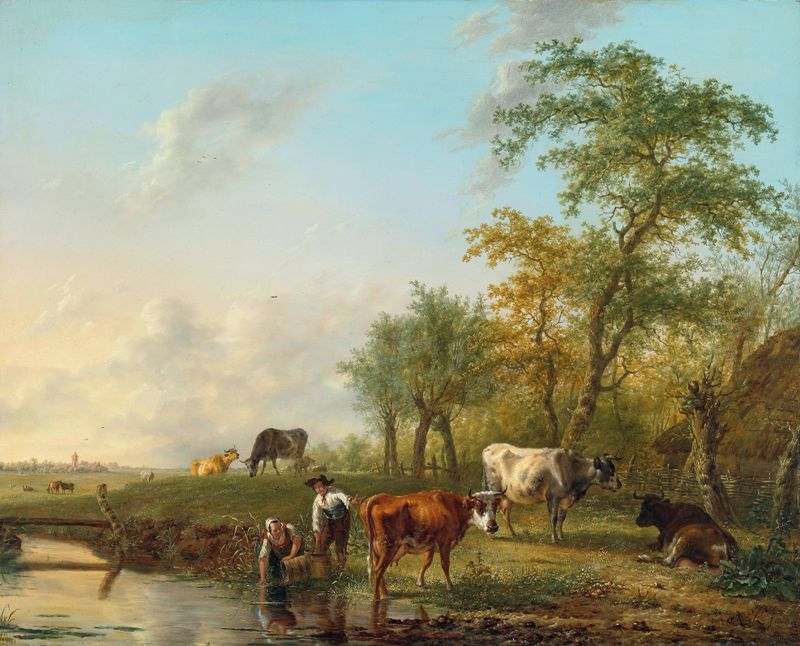
In a world bound by time, where life and death intertwine, how do we reconcile the fleeting moments that shape our existence? Begin your exploration of Landscape with Cattle by focusing on the lush greenery that unfolds in the foreground. Notice how the brushstrokes breathe life into the verdant pastures, inviting the viewer’s gaze to drift toward the serene cattle grazing peacefully. The muted hues of green and brown exhibit a soft, inviting warmth, contrasting the subdued tones of the sky, which is tinged with a promise of twilight.
This balance of color fosters a sense of tranquility, yet hints at the inevitable passage of time. As you delve deeper, observe the subtle interplay between the animals and their environment—each figure frozen in a moment of stillness, capturing the essence of mortality. The cattle, though alive, stand as silent witnesses to the cyclical nature of life, each breath a reminder of what is transient. The distance creates a sense of isolation, suggesting that beyond this serene scene lies a world of uncertainty, a quiet tension that lingers in the air like an unspoken truth. Jan Kobell II painted this work in 1804, during a period marked by the shifting tides of Romanticism in the art world.
While he was establishing his reputation in the Netherlands, the background of his life reflected the challenges of a changing society, where the serene pastoral landscape began to clash with the encroaching industrial age. In that year, he captured not just the beauty of nature, but also an enduring contemplation of life’s fragility, leaving a legacy that transcends the mere depiction of cattle upon a canvas.