Landscape with Journey to Emmaus — History & Facts
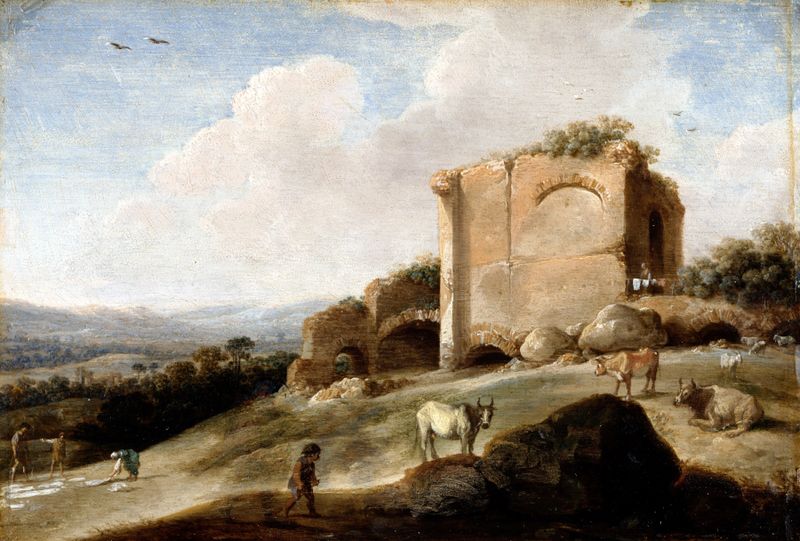
Could a single brushstroke hold eternity? In Landscape with Journey to Emmaus, tranquility envelops the viewer, inviting contemplation and reflection. Look to the left at the warmly lit farmhouse, its sturdy walls a testament to the passage of time. The gentle hues of earth and sky blend seamlessly, while the figure of a traveler on the path draws the eye toward the horizon. Notice how the brilliant light spills across the landscape, illuminating the subtle play of shadow and color, revealing both the serenity of the moment and the underlying tension of a journey undertaken. The painting embodies a narrative rich in symbolism.
The traveler represents the potential for transformation, suggesting that every journey holds the promise of discovery. The serene landscape, juxtaposed with the whisper of impending movement, reflects the emotional duality in our own lives—a stillness that hints at the life-altering experiences that lie ahead. The delicate brushwork captures the moment between departure and arrival, perhaps prompting us to consider our own paths. Charles Cornelisz.
de Hooch painted this work in 1627 during a time when Dutch art was flourishing. Living in Delft, he was influenced by the burgeoning interest in realism and the depiction of everyday life. Amidst the dynamic world of the Dutch Golden Age, this landscape encapsulates a moment of peace, contrasting the vibrant developments around him, and showcasing his mastery of light and space within a serene narrative.