Landscape with Men Sifting Sand — History & Facts
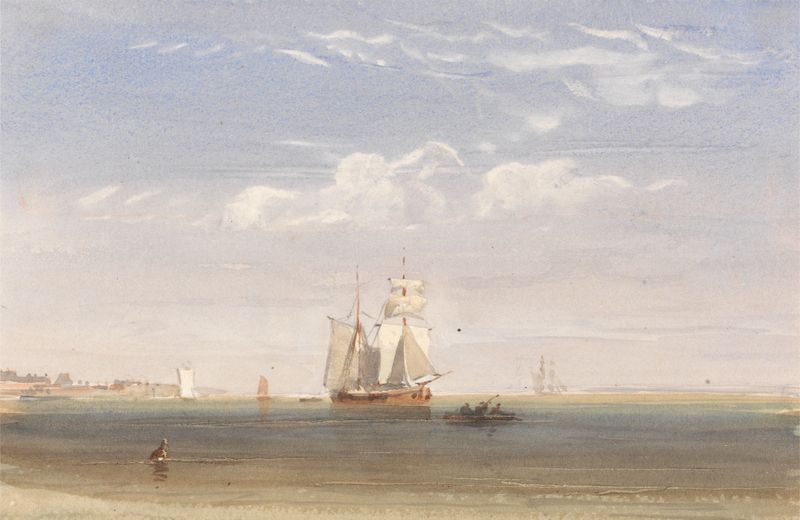
Can beauty exist without sorrow? The delicate balance of nature and human toil in Landscape with Men Sifting Sand offers a poignant reflection on the fragility of both life and artistry. Look closely at the middle ground of the painting, where two figures bend over in labor, their bodies silhouetted against the muted hues of sand and sky. Notice the subtle interplay of light as it filters through the haze, casting a gentle glow on the sand they sift. The artist's brushwork suggests motion, capturing the moment in a soft blur that evokes both the passage of time and the weight of their task, while the cool blues and earth tones harmonize to create a scene that is both serene and somber. There is an inherent tension in this work; between labor and leisure, between the beauty of nature and the struggle of human existence.
The men, seemingly lost in their repetitive task, embody the quiet resilience of ordinary life. The way they are positioned—slightly apart yet part of the same landscape—suggests isolation within community, mirroring the fragility of their connection to the earth and to each other. In the late 1850s, David Cox Jnr. painted this work during a time of immense change within the landscape of British art.
Influenced by the Romantic movement, he sought to capture not just the physical world but the emotional resonance of humanity's relationship with it. His commitment to portraying the beauty of the mundane, amidst a backdrop of industrialization, reveals his sensitivity to the intricate dance of nature and toil.