Landschaft mit Hirte und Viehherde — History & Facts
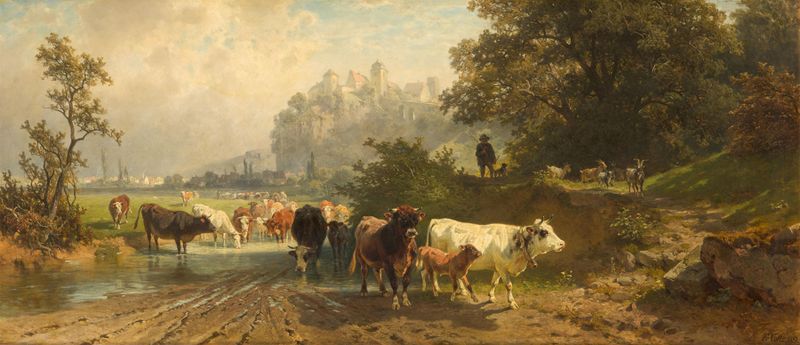
In its stillness, it invites us to ponder the divine connections between nature and humanity, echoing the eternal rhythms of existence. Look to the left of the piece, where a shepherd, clad in modest attire, stands sentinel over his flock. The soft greens and browns of the landscape breathe life into the canvas, while gentle sunlight dapples through the trees, illuminating the flock with a golden hue. Notice how the brushstrokes vary in texture, lending a tactile quality to the woolly coats of the sheep, accentuating their presence as both subjects of the land and symbols of pastoral tranquility. In this serene composition, there’s a profound contrast between the shepherd’s solitary figure and the vibrancy of life surrounding him.
The distant mountains suggest a boundary not of confinement but of spiritual elevation, a reminder of nature’s divinity beyond the earthly realm. The harmonious blend of colors evokes a sense of peace, yet the solitary figure hints at introspection, a moment of reflection amid the chaos of life. Johann Friedrich Voltz created this work in 1883 while living in Munich, a period marked by a growing appreciation for rural themes amidst the industrialization sweeping Europe. This artwork reflects a yearning for a simpler connection to nature, a theme prevalent in the era’s artistic exploration of pastoral life, and demonstrates Voltz's commitment to depicting the beauty of the world he inhabited.