
L’échauguette de l’hôtel de Schomberg à l’angle des rues Bailleul et Jean Tison — History & Facts
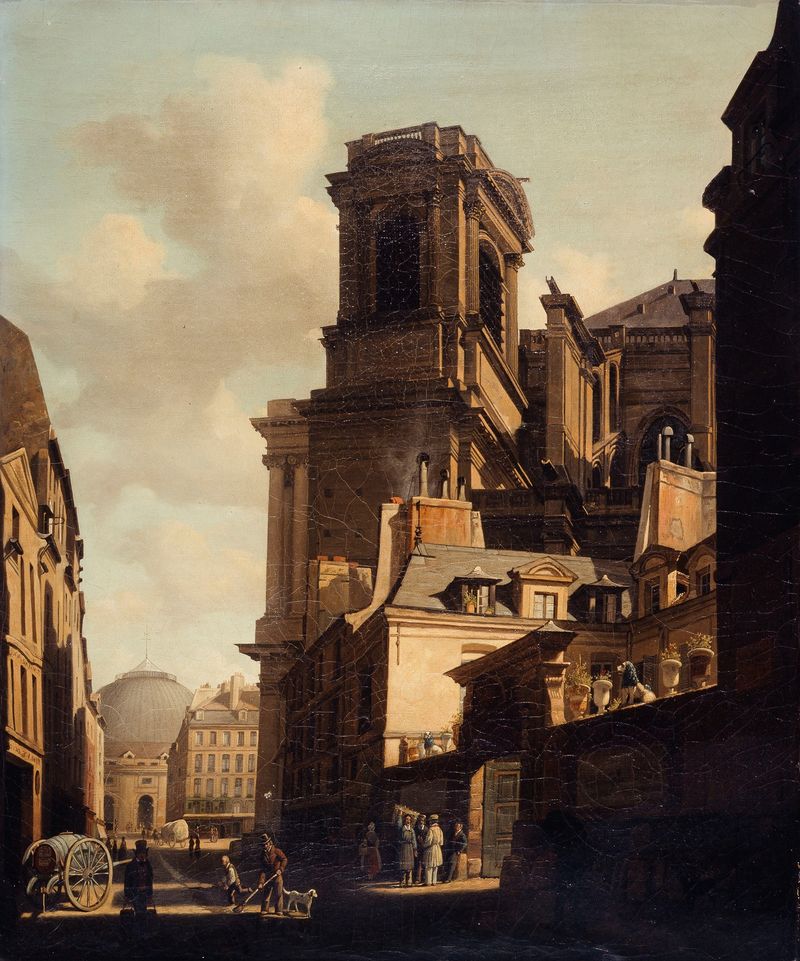
Could a single brushstroke hold eternity? In L’échauguette de l’hôtel de Schomberg à l’angle des rues Bailleul et Jean Tison, melancholy seeps through every hue and contour, creating a space where time lingers, heavy and sweet. First, look to the left at the watchtower, its sharp silhouette rising against a muted sky. The artist employs a soft palette of grays and browns, allowing the architectural lines to blend seamlessly into the backdrop, evoking a sense of historical weight. A gentle play of light casts soft shadows, revealing the delicate textures of the stonework.
This careful attention to detail draws the viewer's eye, inviting exploration into the seemingly quiet corners of the urban landscape. As you delve deeper, observe how the contrasting elements—the stillness of the tower and the blurred figures below—speak to the transience of life within a bustling city. The figures, shrouded in anonymity, reflect the isolation that often accompanies urban existence. Their hurried movements contrast sharply with the timelessness of the structure, suggesting an underlying narrative of longing and loss.
This tension between permanence and ephemerality resonates profoundly, revealing layers of emotion hidden in plain sight. In 1832, Lambert Nollé painted this work amid a turbulent period in French history, marked by political upheaval following the July Revolution. He found himself in Paris, a city abuzz with artistic fervor, as Romanticism began to permeate the art world. Nollé, influenced by the shifting tides of change, captured both the architecture of his surroundings and the emotional weight of a society in flux, creating a poignant reflection that endures through the ages.
More Artworks by Lambert Nollé
Browse all →
More Architecture Art
Browse all →
The statue of Liberty
Frédéric Auguste Bartholdi

View of Houses in Delft, Known as ‘The Little Street’
Johannes Vermeer

View of Houses in Delft, Known as ‘The Little Street’
Johannes Vermeer

The Cathedral in Rouen. The portal, Grey Weather
Claude Monet

The yellow house
Vincent van Gogh

The Church in Auvers-sur-Oise, View from the Chevet
Vincent van Gogh