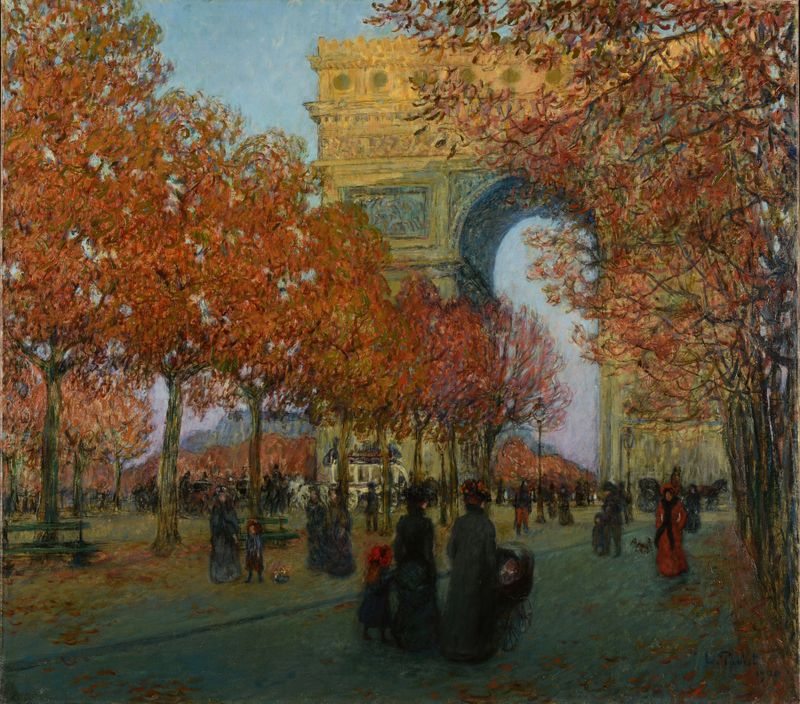
Le Square de la Trinité — History & Facts
What secret hides in the quiet of the canvas? In a world of vibrant chaos, Le Square de la Trinité invites us to pause and reflect upon the subtle beauty of everyday life. Look to the foreground, where the gentle curves of the park's pathway draw your eye through a tapestry of green. Notice how the dappled sunlight filters through the leaves, creating a play of light and shadow that breathes life into the scene. The warm ambers and soft greens evoke a comforting atmosphere, inviting the viewer into this serene moment.
The careful arrangement of trees, benches, and people creates a harmonious visual rhythm, allowing the composition to flow with an effortless grace. However, beneath this tranquil surface lies a deeper emotional current. The distant figures, seemingly absorbed in their own thoughts, evoke a sense of solitude amidst the shared space. The juxtaposition of the bustling city nearby, hinted at in the background, contrasts sharply with the intimate stillness of the square.
This tension between urban life and personal reflection speaks to the human experience — a search for transcendence amid the mundane. Around 1900, Paviot painted this work during a time when Paris was undergoing rapid modernization and artistic transformation. A member of the Société Nationale des Beaux-Arts, he was immersed in an environment that celebrated the beauty of everyday scenes. As the world around him evolved, Le Square de la Trinité captures a moment of peace, allowing viewers to escape the noise of progress and linger in the quietude of nature.