
L’église de Saint-Germain-l’Auxerrois — History & Facts
Can paint confess what words never could? Beneath the brushstrokes lies a chaos of thought, a visual cacophony that invites reflection on the thin line between sanity and madness. Look to the center where the church stands tall, its spires reaching up as if seeking solace from the heavens. Notice how the artist captures the warmth of late afternoon light, bathing the façade in a golden hue yet simultaneously casting shadows that stretch like dark fingers across the cobblestones. The brushwork is both delicate and frenetic, drawing your gaze from the intricate details of the architecture to the enveloping atmosphere that surrounds the scene. In the interplay of light and shadow, there exists a tension that hints at underlying turmoil.
The vibrant colors contrast sharply with the darkened corners of the composition, suggesting a hidden madness that lurks just beyond the visible. Small figures moving throughout the scene appear almost as specters, embodying a sense of disconnection, while the church itself stands as a beacon of presence—an anchor amidst the chaos. This duality reveals the artist's exploration of faith and despair, illustrating a world caught in the throes of an unseen conflict. Auguste Wynantz painted this work in 1840 while living in Paris, a city marked by the tension between tradition and the burgeoning modernity of the age.
At this time, the world of art was rapidly evolving, with Romanticism giving way to Realism, influencing the artist's approach to capturing both architectural beauty and the emotional resonance of urban life.
More Artworks by Auguste Wynantz
Browse all →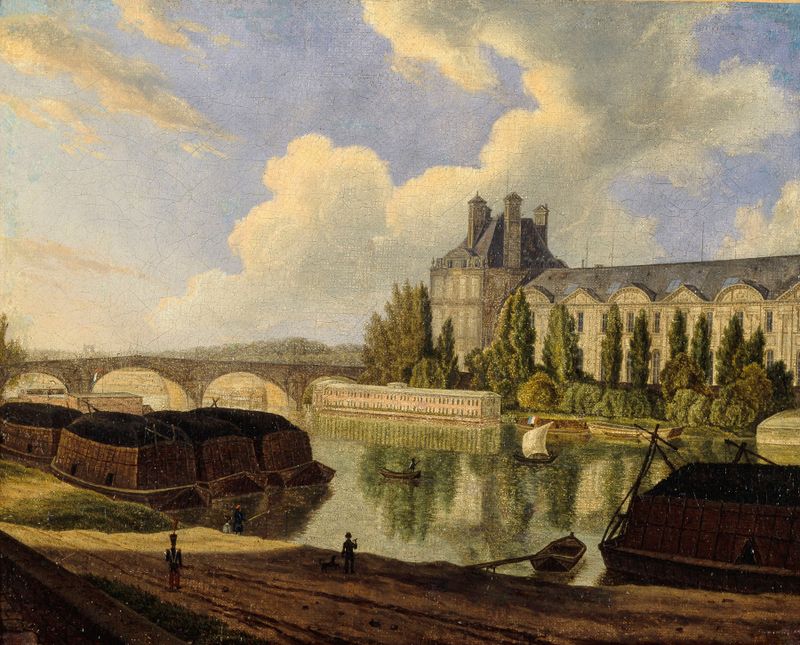
More Architecture Art
Browse all →
The statue of Liberty
Frédéric Auguste Bartholdi

View of Houses in Delft, Known as ‘The Little Street’
Johannes Vermeer

View of Houses in Delft, Known as ‘The Little Street’
Johannes Vermeer

The Cathedral in Rouen. The portal, Grey Weather
Claude Monet

The yellow house
Vincent van Gogh

The Church in Auvers-sur-Oise, View from the Chevet
Vincent van Gogh