
London Bridge — History & Facts
In a world where memories fade like the mist over the Thames, grief weaves itself through the fabric of our existence, leaving a longing that is both personal and collective. Look closely at the careful brushstrokes that depict the iconic bridge, each wave of color layering a story of loss. The somber hues of gray and blue mirror the spectral atmosphere, while a soft golden light filters through the clouds, hinting at hope amid sorrow. Notice how the figures in the foreground, clad in muted tones, appear almost ghost-like, their gestures caught between the past and the present, as if they are navigating the weight of memory itself. The emotional tension in this piece lies in the contrast between the sturdy structure of the bridge and the ephemeral nature of the water beneath it.
The bridge, a symbol of connection, stands resolute, yet it is surrounded by an atmosphere of melancholy. The reflections in the water carry traces of the past, suggesting that while we strive to move forward, memories continue to ripple through our lives, shaping our identities and experiences. Created in a period of artistic exploration, the piece was painted during an era when Kerr-Lawson was experimenting with the interplay of light and emotion. The late 19th century was rife with changes in British society, and the artist was part of a movement that sought to capture the nuances of the human experience through landscape and cityscape.
This work encapsulates that desire to confront and convey the bittersweet nature of memory and belonging.
More Artworks by James Kerr-Lawson
Browse all →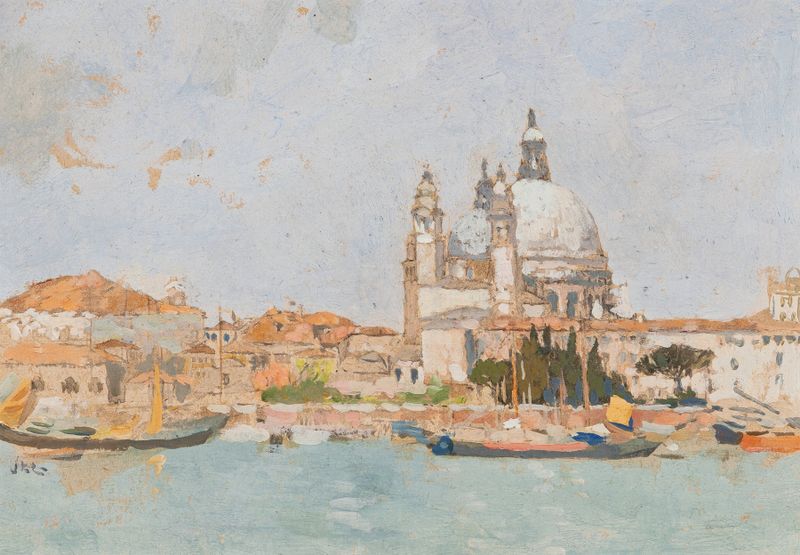


More Architecture Art
Browse all →
The statue of Liberty
Frédéric Auguste Bartholdi

View of Houses in Delft, Known as ‘The Little Street’
Johannes Vermeer

View of Houses in Delft, Known as ‘The Little Street’
Johannes Vermeer

The Cathedral in Rouen. The portal, Grey Weather
Claude Monet

The yellow house
Vincent van Gogh

The Church in Auvers-sur-Oise, View from the Chevet
Vincent van Gogh