
L’usine à gaz de Courcelles — History & Facts
In this era of industrial transformation, creativity becomes a refuge for the human spirit, where illusion melds into reality. Focus on the industrial landscape, where the gas factory looms large against the skyline. The intricate details of the wrought iron and brickwork command your attention, revealing a symphony of geometric shapes intertwined with the organic forms of the surrounding trees. The artist's use of muted grays and earth tones contrasts sharply with the bright flicker of gaslight, evoking a tension between the natural world and human ingenuity. Notice the subtle play of light across the scene, illuminating the factory’s façade while casting shadows that imbue the structures with a sense of foreboding mystery.
The juxtaposition of the factory’s rigid lines against the soft, flowing curves of nature hints at a complex relationship: one of coexistence and conflict. Each element serves as a reminder of the relentless march of progress and the cost it extracts from the environment and society. In 1884, Delahaye painted this piece during a period of rapid industrialization in France, reflecting the anxieties and aspirations of a society on the brink of modernity. Urbanization was reshaping the landscape, and artists grappled with capturing the essence of a world undergoing profound change.
This work stands as a testament to the artist's keen observation of the era and his ability to convey deeper truths through the lens of the evolving cityscape.
More Artworks by Ernest Jean delahaye
Browse all →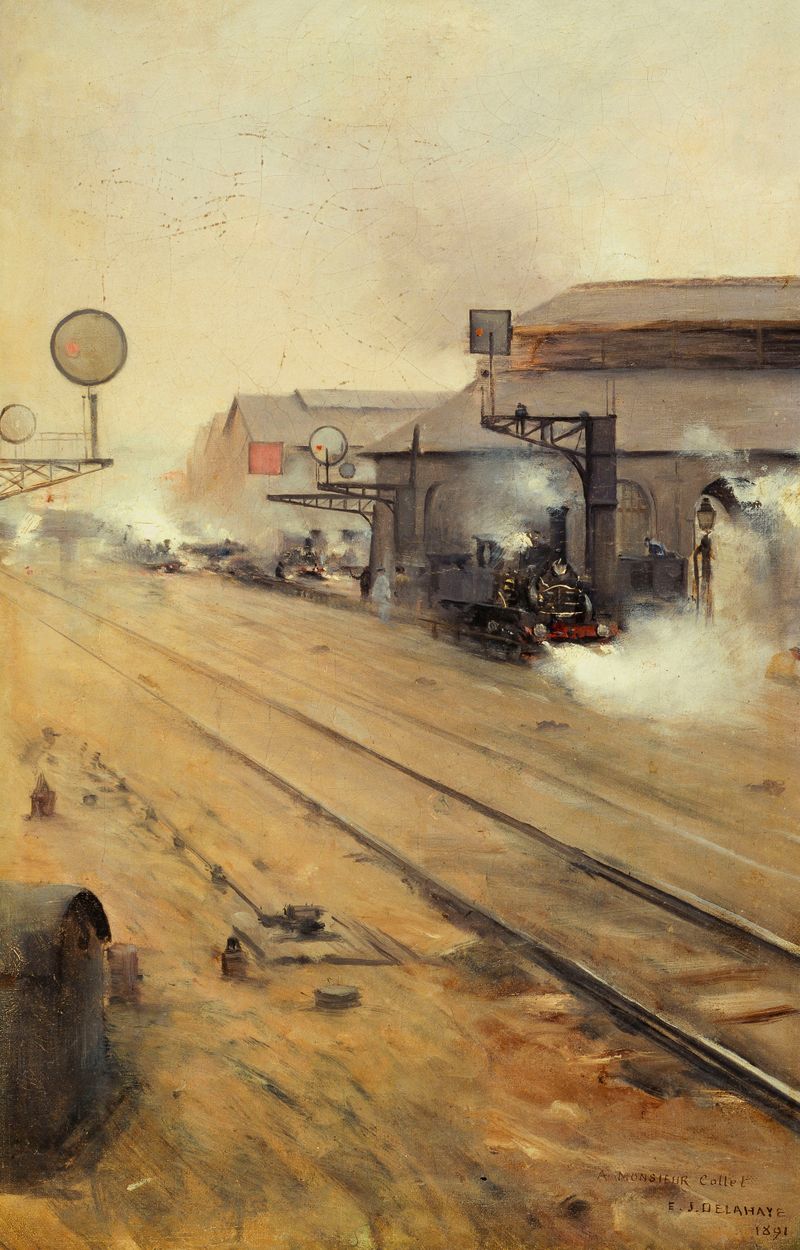
More Architecture Art
Browse all →
The statue of Liberty
Frédéric Auguste Bartholdi

View of Houses in Delft, Known as ‘The Little Street’
Johannes Vermeer

View of Houses in Delft, Known as ‘The Little Street’
Johannes Vermeer

The Cathedral in Rouen. The portal, Grey Weather
Claude Monet

The yellow house
Vincent van Gogh

The Church in Auvers-sur-Oise, View from the Chevet
Vincent van Gogh