Marsh — History & Facts
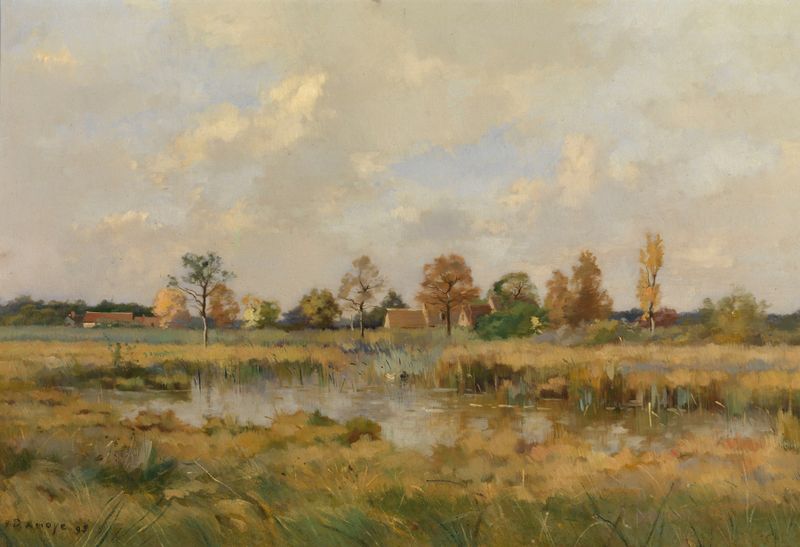
In the vastness of our memories, nostalgia sways like a gentle breeze, compelling us to revisit moments now enveloped in the soft hues of time. Look to the foreground of Marsh, where delicate grasses sway, their greens harmonizing with the amber tones of a fading sun. The brushstrokes dance across the canvas, creating a textured tapestry that invites the viewer to step closer, to feel the softness of each blade against the skin. Notice how the light falls upon the water, shimmering in a palette that mirrors the serenity of the scene, inviting contemplation and peace.
The composition beckons the eye into the depths of the marsh, where reflections ripple like whispered secrets. Beneath this tranquil exterior lies an emotional complexity, evoking a sense of longing for a world that ebbs and flows like the very waters depicted. The contrasts between the vibrant greens and muted browns embody a tension between life and decay, suggesting the cyclical nature of existence. Each brushstroke seems to capture a fleeting moment, hinting at a nostalgia for both the beauty captured and what has been lost in time. Pierre Emmanuel Damoye painted Marsh in 1897 while living in France, a period marked by an embrace of Impressionism and a burgeoning interest in capturing nature's fleeting moments.
During this time, he was influenced by the transition in art towards more expressive color and light, reflecting both personal and societal changes amid the evolving artistic landscape. Damoye's work serves as a poignant testament to the delicate interplay between memory, nature, and the passage of time.