
Mausoleum at Outatori near Trichinopoly — History & Facts
Obsession weaves through the fabric of art, revealing the delicate balance between allure and despair. Look to the foreground, where intricate carvings stand as sentinels of time. Notice how the light dances across the surface of the mausoleum, highlighting the play of shadows that cradle its ornate details. The artist’s careful brushwork reveals a profound engagement with texture; stone seems almost liquid against a backdrop of vibrant blues and ochres, creating a striking contrast that pulls the viewer in. As you explore further, subtle nuances emerge.
The crumbling edges of the mausoleum suggest decay, a whisper of mortality beneath its gilded splendor. Each arch and column tells a story of ambition, yet the overgrown foliage encroaching upon its base adds a poignant reminder of nature's reclaiming touch. Here, the obsession with permanence meets the inevitability of dissolution, inviting contemplation on the transience of beauty. Francis Swain Ward painted this piece during a time when the British fascination with India and its architectural marvels heightened.
Operating in the mid-19th century, he drew from both his travels and the burgeoning interest in exoticism within the art world. As he captured this mausoleum near Trichinopoly, he was not merely recording history; he was immortalizing a moment rife with the tension of decay and beauty, reflecting a broader dialogue on life and art.
More Artworks by Francis Swain Ward
Browse all →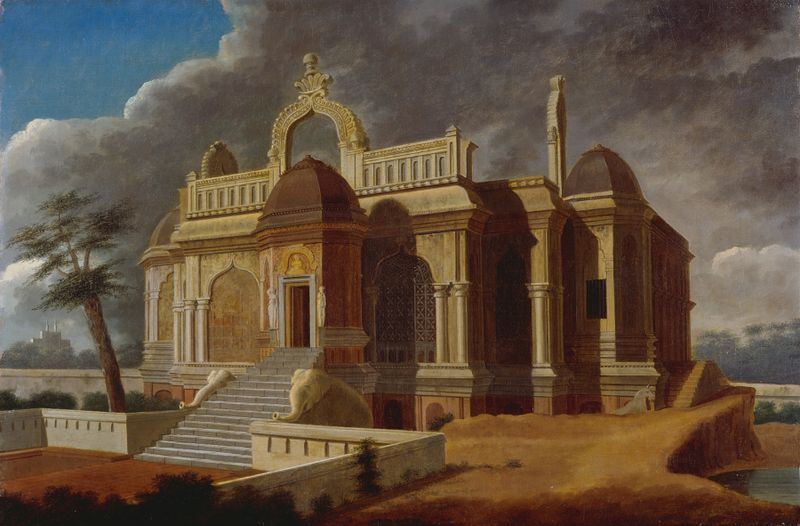
More Architecture Art
Browse all →
The statue of Liberty
Frédéric Auguste Bartholdi

View of Houses in Delft, Known as ‘The Little Street’
Johannes Vermeer

View of Houses in Delft, Known as ‘The Little Street’
Johannes Vermeer

The Cathedral in Rouen. The portal, Grey Weather
Claude Monet

The yellow house
Vincent van Gogh

The Church in Auvers-sur-Oise, View from the Chevet
Vincent van Gogh