
Mausoleum with Stone Elephants — History & Facts
Who listens when art speaks of silence? In Mausoleum with Stone Elephants, the stillness of the scene reverberates with the echoes of memories, inviting introspection and contemplation about mortality and legacy. Look to the left, where the majestic stone elephants stand sentinel, their monumental forms perfectly rendered in cool grays and whites that mimic the texture of ancient marble. The mausoleum, draped in an ethereal light, dominates the composition, its architectural lines guiding the eye upward, suggesting elevation to the realm beyond. The subtle play of shadows emphasizes the depth and gravitas of the scene, creating an almost dreamlike quality that contrasts with the tangible weight of the stone. Within this tranquil yet profound tableau lies a meditation on remembrance and the passage of time.
The elephants symbolize strength and memory, while the mausoleum signifies a final resting place, embodying the illusion of permanence in a world that is inherently transient. The stillness of the scene prompts viewers to consider the stories intertwined with these stone figures, evoking the silent conversations between the living and the departed. In 1788, Francis Swain Ward crafted this work during a period when neoclassicism permeated the artistic landscape, emphasizing grandeur and historical references. Living in England at the time, Ward was engaged in a cultural milieu that valued monumental architecture and allegorical subjects, reflecting a growing fascination with the intersection of art, history, and memory.
This painting not only captures the era’s aesthetic but also serves as a poignant reflection on the human condition.
More Artworks by Francis Swain Ward
Browse all →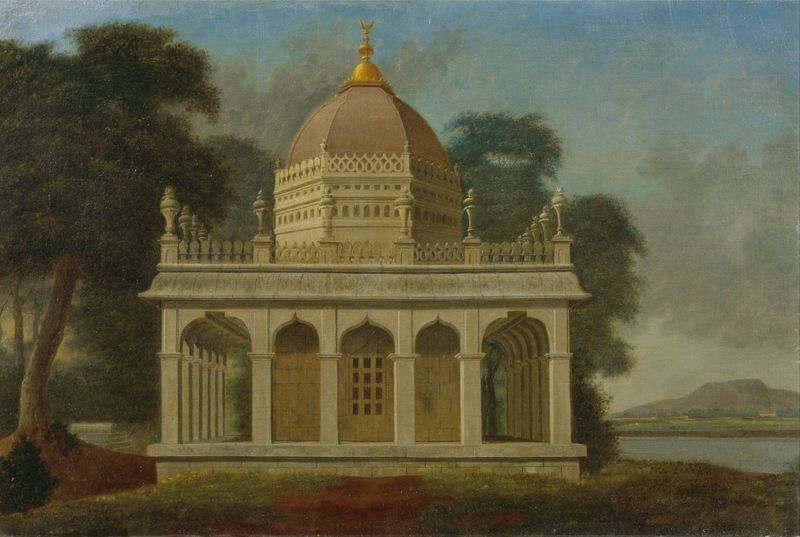
More Architecture Art
Browse all →
The statue of Liberty
Frédéric Auguste Bartholdi

View of Houses in Delft, Known as ‘The Little Street’
Johannes Vermeer

View of Houses in Delft, Known as ‘The Little Street’
Johannes Vermeer

The Cathedral in Rouen. The portal, Grey Weather
Claude Monet

The yellow house
Vincent van Gogh

The Church in Auvers-sur-Oise, View from the Chevet
Vincent van Gogh