Mount Lagrev — History & Facts
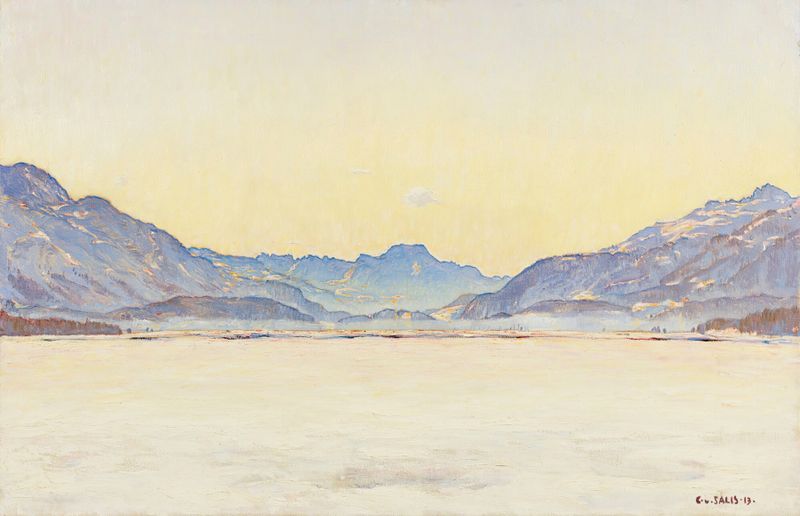
Could beauty survive in a century of chaos? In Mount Lagrev, the serene landscape presents a moment of tranquility, inviting introspection amid the tumult of human existence. The painting stands as a testament to nature’s resilience and the quiet power it holds within its embrace. Look to the foreground, where the delicate interplay of greens and ochres suggests the richness of the earth. Notice how the gentle brushstrokes evoke the texture of foliage; each blade of grass is painted with care, capturing the essence of life.
As you gaze upward, the palette shifts to cooler hues—the soft blues and whites of the sky infused with clouds that whisper tales of change. The mountain rises majestically in the distance, its peak kissed by sunlight, drawing the viewer's eye toward the horizon where earth meets sky. The composition reveals a delicate balance between peace and looming uncertainty. The mountain, despite its strength, hints at challenges ahead, symbolizing the struggle between man and nature.
The reflective quality of the water below not only mirrors the grandeur above but also suggests a depth of thought—an invitation to ponder our place in the world. The contrast between the vibrant land and the still, reflective waters evokes a sense of duality, urging us to consider the harmony and discord within our lives. Created during a period of introspection in 19th-century Europe, the artist painted this work as the world was on the brink of immense change—politically and socially. The era was marked by rapid industrialization and shifting ideologies, which stirred a desire to return to nature’s beauty.
In this context, Mount Lagrev serves not just as a visual feast but as a profound commentary on the enduring power of the natural world amidst the chaos of human advancement.