Muly Moloch — History & Facts
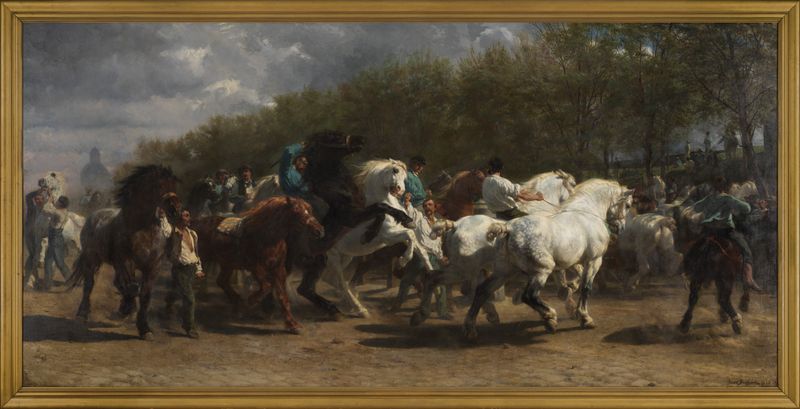
Did the painter know this moment would outlive them? In Muly Moloch, beauty exists as a haunting echo, challenging the fleeting nature of time itself. Look closely at the graceful form of the horse, its muscular frame captured in fluid motion, embodying both strength and elegance. Notice how the warm light washes over the creature, accentuating the textures of its flowing mane and the sheen of its coat. The background, rendered in softer hues, provides a serene contrast, allowing the horse's powerful presence to dominate the canvas.
Each brushstroke speaks of careful observation, the vibrant palette pulsating with life and energy. Beneath the surface, the painting reflects a deeper tension: the juxtaposition of wild beauty and the encroaching hand of civilization. The horse, a symbol of freedom and untamed spirit, stands poised against a backdrop that hints at the passage of time and the constraints of human progress. Small details, like the subtle play of shadow across its flank, suggest that beauty can be both ephemeral and eternal, inviting contemplation of our relationship with the natural world. Created in 1803, Muly Moloch emerged during a transformative period for Benjamin Marshall, who was deeply immersed in the Romantic movement.
Living in England, he sought to capture the essence of his subjects through vivid realism, while the world around him was shifting rapidly due to industrialization. This work reflects not just an artistic aspiration but an awareness of the beauty at risk of being lost in the march of progress.