On the Hoher Frassen — History & Facts
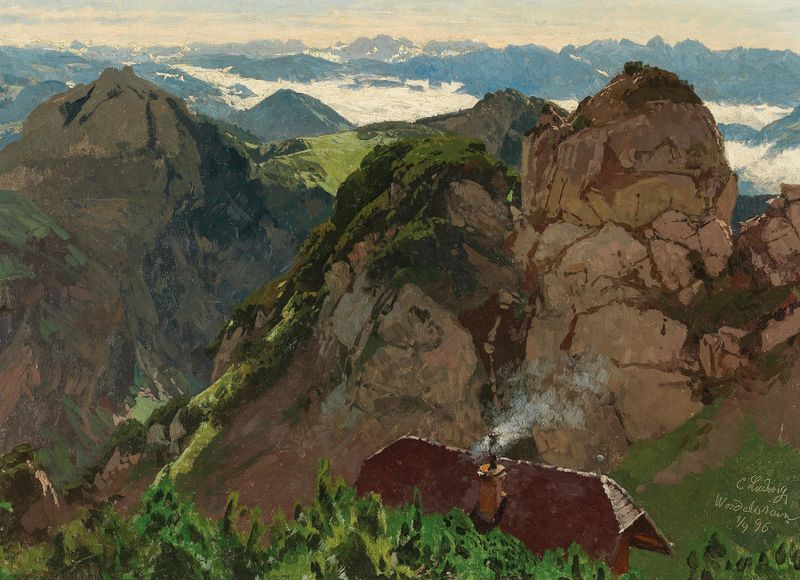
In the realm of art, color speaks in whispers, revealing truths often left unspoken. It holds the power to evoke emotions, to pull us into a world where feelings collide and harmonize in a dance of hues. Look at the vibrant green that anchors the foreground. The rich saturation pulls your gaze toward the lush foliage, inviting you to explore the intricate play of light filtering through the leaves.
Notice how the subtle gradients of blue and purple in the background create a sense of depth as they recede into soft shadows, suggesting an expansive sky that beckons you to wander beyond the canvas. Every brushstroke is intentional, guiding the viewer’s eye through a serene yet densely layered landscape. This piece explores the tension between the vibrant life depicted and the quiet solitude it implies. The colors vibrate with energy, yet there’s a palpable stillness that suggests introspection and contemplation.
The contrast between the lively greens and the muted atmospheric tones speaks to the duality of existence — the joy of life intertwined with the serenity found in moments of solitude. It’s an exploration of how nature offers both comfort and a space for reflection. Created during a time when the artist was immersed in the natural landscape of his surroundings, this work showcases the transition into a style that captures emotion through color. Though the exact date remains uncertain, it reflects a period where the emphasis on nature was pivotal in the evolution of artistic expression within the 19th century, addressing the growing appreciation for the emotional resonance of natural settings.