Orchard in Winter — History & Facts
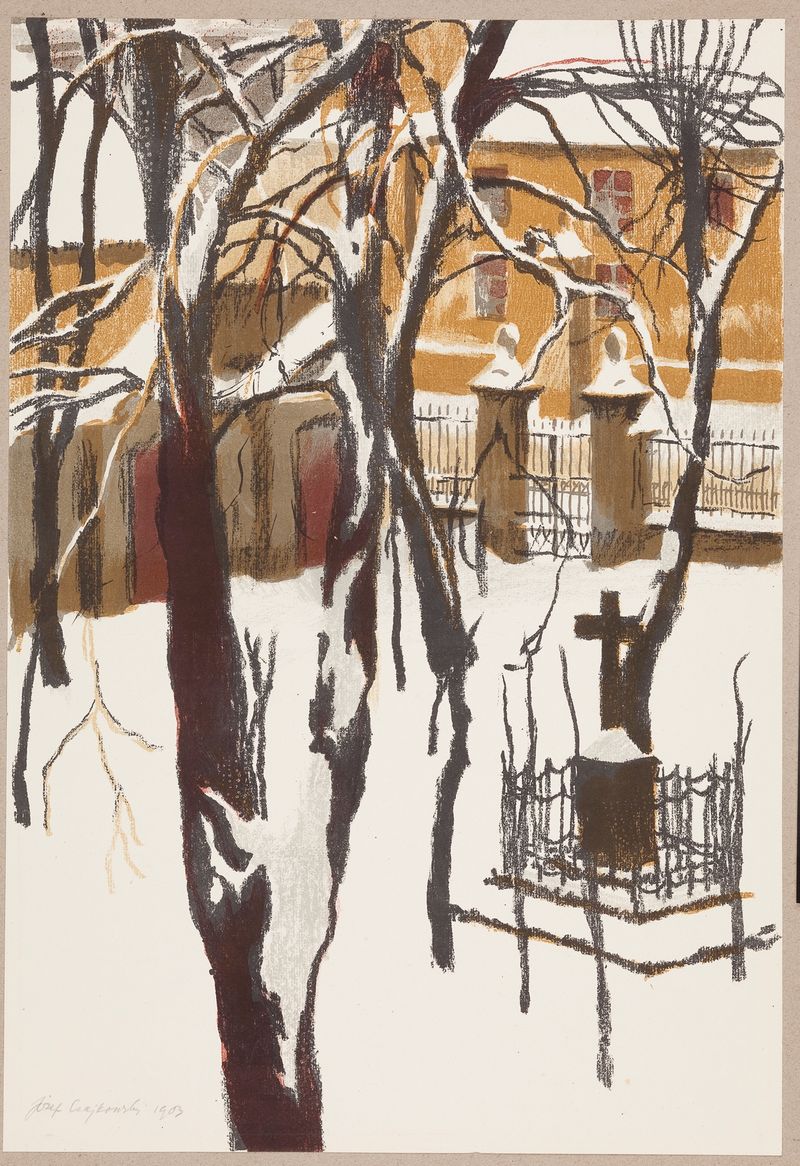
Can beauty exist without sorrow? In Orchard in Winter, a haunting stillness envelops the landscape, where nature’s quietude speaks volumes of both desolation and revelation. Look to the center of the canvas, where gnarled branches stretch gracefully against a pale sky, their skeletal forms draped in a delicate layer of frost. Notice how the muted palette—soft whites, grays, and browns—creates a somber atmosphere, inviting contemplation. The play of light is subtle yet powerful, as it dances across the icy terrain, illuminating the fragile beauty that comes with winter's grasp. Yet beneath this serene surface lies an emotional tension.
The starkness of the orchard mirrors a deeper contrast: life paused in a season of dormancy, evoking both nostalgia and the promise of renewal. The tension between the lifeless branches and the crisp white snow symbolizes a quiet endurance, suggesting that even in the depths of winter, beauty persists, waiting for the thaw of spring. Each element holds significance, conjuring reflections on loss, resilience, and the cyclical nature of existence. In 1900, while creating this piece in Poland, Józef Czajkowski was navigating a significant chapter in his life as an artist.
The turn of the century brought a wave of artistic experimentation across Europe, and Czajkowski, influenced by both Impressionism and Post-Impressionism, sought to encapsulate the essence of landscape in its most honest form. At this time, the world was on the cusp of transformation, and his work reflects a deep engagement with the emotional landscapes of his environment.