Pappeln — History & Facts
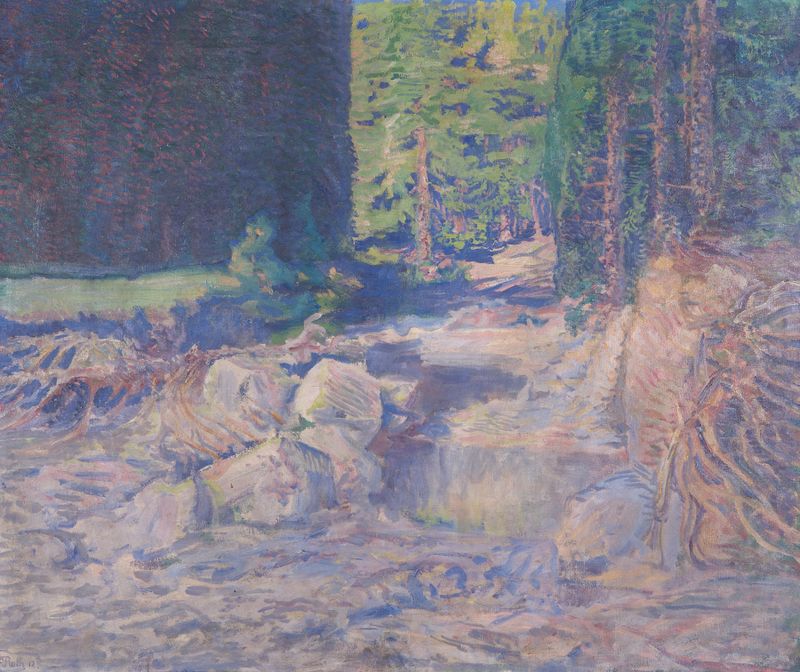
What if beauty was never meant to be finished? In Pappeln, August Roth invites us to explore the delicate interplay between nature and the artist's vision, capturing a moment that feels both timeless and fleeting. Focus on the lush greens and deep browns in the landscape, where the tall poplars rise majestically against the sky. Notice how the dappled sunlight filters through the branches, casting a soft glow on the ground below. The brushwork conveys a sense of movement, as if the trees are swaying gently in a whispering breeze, while the fluidity of Roth's strokes evokes the very pulse of life within the scene. Beneath the tranquil exterior lies a tension between permanence and transience.
The towering trees stand as guardians of an ephemeral moment, their leaves shimmering in a dance of light that emphasizes the cycle of nature—growth, decay, and rebirth. The juxtaposition of the sturdy trunks against the delicate foliage reflects a duality of strength and fragility, urging the viewer to confront the inevitable passage of time and the beauty found within it. In 1910, Roth created this piece during a period of personal evolution, as he was transitioning from academic influences to a more expressive style. Living in Berlin, he was immersed in the vibrant art scene that was beginning to embrace modernism.
The world around him was shifting rapidly, and this work stands as a testament to his desire to capture not just a scene, but a feeling—a moment of awakening in both nature and his own artistic journey.