Paturage En Auvergne — History & Facts
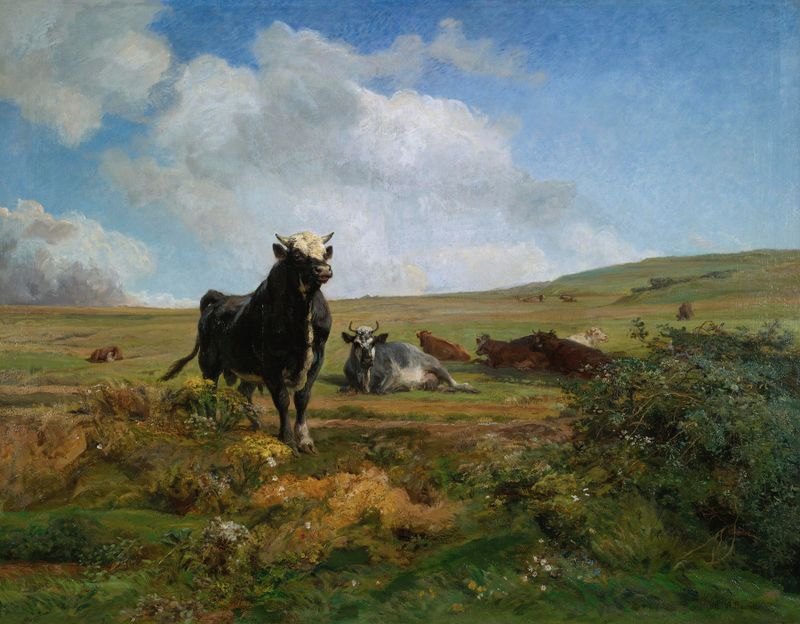
Is this a mirror — or a memory? In the quiet expanse of Paturage En Auvergne, the landscape whispers tales of both serenity and unease, where every blade of grass and shadow holds a story of fear and longing. To your left, observe the gentle curve of the rolling hills, lush and inviting, painted in layers of green that invite a breath of fresh air. Now, shift your gaze to the foreground, where a solitary cow grazes, its presence both tranquil and haunting. The play of light across the animal's coat reveals a meticulous attention to detail, showcasing brushstrokes that capture the softness of the fur against the harshness of reality. In this idyllic setting, the juxtaposition of peace and vulnerability emerges.
The expansive landscape suggests freedom, yet the solitary figure evokes a sense of isolation, hinting at the inexorable ties to a life tethered to the land. The horizon looms in the background, hinting at storms or uncertainty, allowing viewers to feel the tension between the beauty of nature and the fear of its unpredictability. Created during a time when societal changes were rippling through France, the artist painted this work in the mid-19th century, at a point of personal growth and professional acclaim. An emerging voice in the world of realism, Bonheur sought to connect viewers with the unvarnished essence of rural life, reflecting both the tranquility of nature and the underlying anxieties of existence.