Paysage Breton — History & Facts
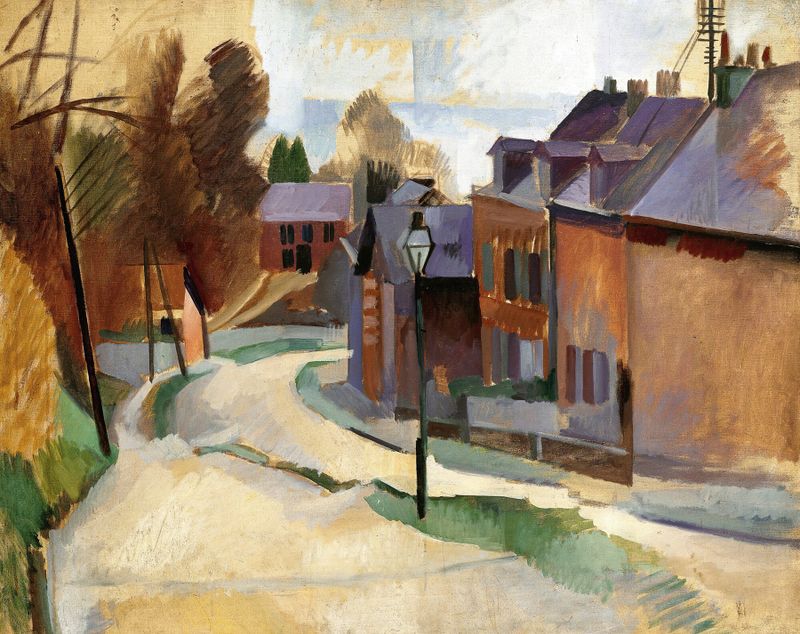
Did the painter know this moment would outlive them? In Paysage Breton, the vibrant interplay of light and color seems to whisper the secret of eternity, inviting the viewer into its luminous embrace. Focus on the swirling hues that converge and diverge across the canvas. The bold brushstrokes mimic the rhythm of nature, capturing the essence of a landscape alive with energy. Notice how the light falls upon the undulating forms, creating a dance of shadows and brightness that lead your eyes through the scene.
The soft blues and greens juxtaposed with fiery oranges and reds evoke the shifting moods of the Breton sky and earth, while the near-abstract composition challenges traditional perspectives, suggesting a deeper connection to the moment. Embedded in this work are contrasts that speak volumes: the harmony of nature against the chaos of human experience, the fleeting against the eternal, movement against stillness. Each stroke pulsates with emotion, reflecting both the serenity of the landscape and the tumult of the artist’s inner world. This duality invites contemplation about the nature of perception and the passage of time, as light transforms the familiar into the extraordinary. In 1906, Delaunay was immersed in the vibrant art scene of Paris, where the shift towards modernism was in full bloom.
The artist was deeply influenced by the Impressionists and the emerging fauvist movement, exploring the relationship between color and perception. As he painted Paysage Breton, he was also grappling with his own artistic identity, seeking to express the dynamism of the world around him through innovative techniques and bold color choices.