Preussische Brigg ‘Charlotte’ — History & Facts
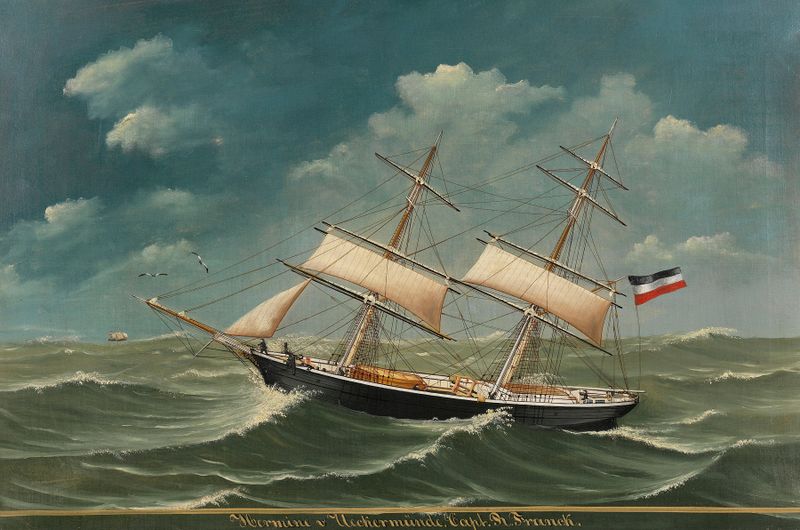
Is this a mirror — or a memory? In the stillness of Preussische Brigg ‘Charlotte’, the waters reflect not only the ship but the weight of loss that lingers beneath the surface. Look to the left at the delicate outlines of the hull, rendered with a meticulous attention to detail that draws your eye toward the somber gray sky. Notice how the muted blues and greens of the water blend into one another, creating a depth that feels both inviting and melancholic. The soft brushstrokes evoke a sense of movement, as if the ship is poised to navigate the tides of remembrance. Beyond the ship, the interplay of light and shadow suggests a narrative of absence.
The shimmering surface of the water seems to hold the ghosts of those who have traversed these waters, intertwining hope with grief. The lone vessel stands as a silent homage, embodying the weight of journeys taken and the inevitable farewells that accompany them. In this contrast, the viewer senses a profound solitude, an echo of longing that resonates deeply within the heart. August Lasczky created this work in 1865, during a time of significant change in the art world, where realism was gaining ground against romantic notions.
Living in Germany, he sought to capture the essence of maritime life and its connections to memory, reflecting his personal experiences with loss and the passage of time. The painting serves as a poignant reminder of how art can navigate the delicate waters of human emotion.