
Putti en engel met cartouche — History & Facts
In the stillness of Putti en engel met cartouche, destiny hangs delicately in the balance, urging us to ponder what the future may hold. Look to the center, where the cherubic figures, the putti, playfully embrace their ethereal counterpart, the angel. Their rounded forms appear weightless against a backdrop rich with muted golds and whites, inviting your gaze to dance across the intricate cartouche that frames the scene. The artist’s meticulous brushstrokes create a lush texture, each curve and contour evoking a palpable sense of joy and innocence, while the warm palette suggests an atmosphere of divine grace. Beneath the surface, the work pulses with contrasting themes.
The putti's exuberance juxtaposes the serene presence of the angel, embodying the tension between earthly delights and heavenly aspirations. The cartouche, often a symbol of destiny or legacy, subtly reminds us of the weight of expectation that accompanies joy. This balance of playfulness and solemnity compels the viewer to reflect on their own path, as each figure seems to echo the questions of fate that linger in the air. During the period from 1587 to 1637, Wtewael was deeply embedded in the Dutch Mannerist movement, flourishing in Utrecht.
His works often fused playful themes with intricate detail, reflecting both personal exploration and a broader Renaissance fascination with harmony and beauty. This canvas emerged from a time of cultural prosperity, where art was a medium for both celebration and contemplation, mirroring the complex tapestry of human experience.
More Artworks by Joachim Wtewael
Browse all →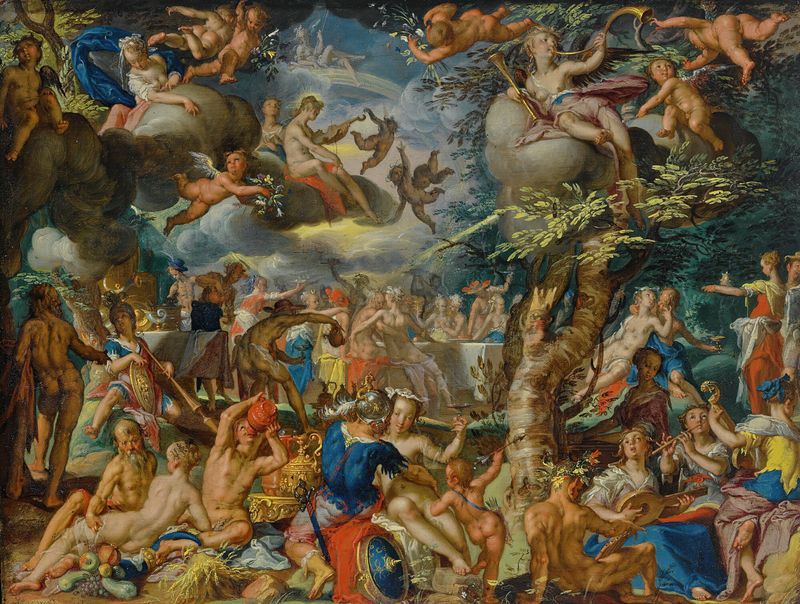


More Religious Art
Browse all →
The Return of the Prodigal Son
Rembrandt van Rijn

The Garden of Earthly Delights
El Bosco

Count Orgaz’ funeral
El Greco

The Hundred Guilder Print: the central piece with Christ preaching, the plate arched
Rembrandt van Rijn

The Descent from the Cross
Rogier van der Weyden

The return of the prodigal son
Rembrandt van Rijn