
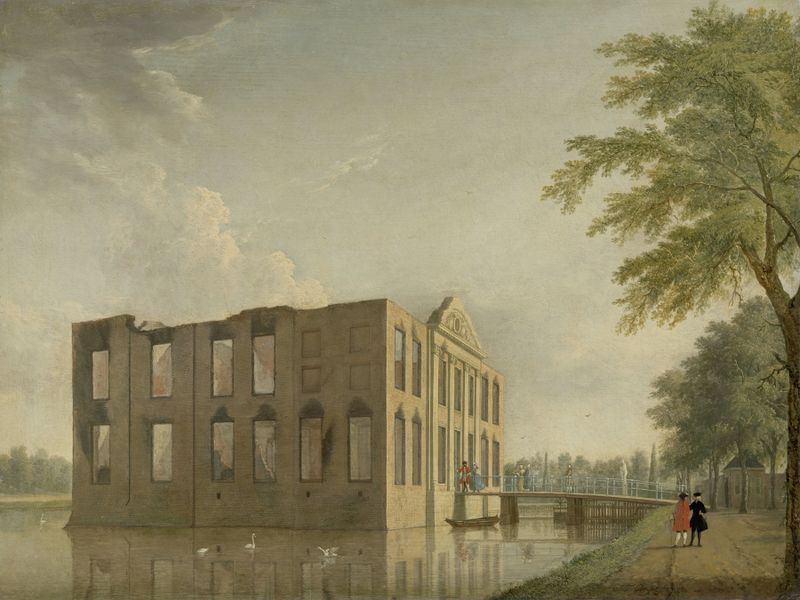
Rear View of Berckenrode Castle in Heemstede after the Fire — History & Facts
Could a single brushstroke hold eternity? In Rear View of Berckenrode Castle in Heemstede after the Fire, the artist invites us to contemplate the fragile line between existence and oblivion, capturing a moment where history and memory intertwine. Look to the left at the charred remnants of the castle, where the smoke lingers like a ghost of a once-magnificent structure. Notice how the somber, muted palette of greys and browns evokes a sense of loss, while the delicate strokes of the surrounding landscape offer a stark contrast of life amidst ruin. The artist’s meticulous attention to detail in the foliage and distant trees underscores the quiet resilience of nature, as though to suggest that time, though destructive, also nurtures renewal. Hidden within the ruins lie complex emotions, as the wreckage speaks to mortality and the impermanence of human endeavor.
The juxtaposition of fire's devastation against the serene beauty of the natural world raises questions about what is left behind after catastrophe and how memory shapes our understanding of both past and present. Each brushstroke becomes a meditation on the transient nature of existence, inviting viewers to reflect on their own legacies and the echoes of what once was. Jan ten Compe painted this work in 1747 during a period marked by a growing interest in the romanticization of ruins in art. Living in the Netherlands, he was part of a cultural landscape that was grappling with its own historical narratives, often reflecting the tension between destruction and preservation.
This painting not only memorializes a specific moment of loss but also situates itself within broader artistic movements that sought to articulate the human experience in relation to time and memory.
More Artworks by Jan ten Compe
Browse all →

More Architecture Art
Browse all →
The statue of Liberty
Frédéric Auguste Bartholdi

View of Houses in Delft, Known as ‘The Little Street’
Johannes Vermeer

View of Houses in Delft, Known as ‘The Little Street’
Johannes Vermeer

The Cathedral in Rouen. The portal, Grey Weather
Claude Monet

The yellow house
Vincent van Gogh

The Church in Auvers-sur-Oise, View from the Chevet
Vincent van Gogh