Red and White Plum Blossoms — History & Facts
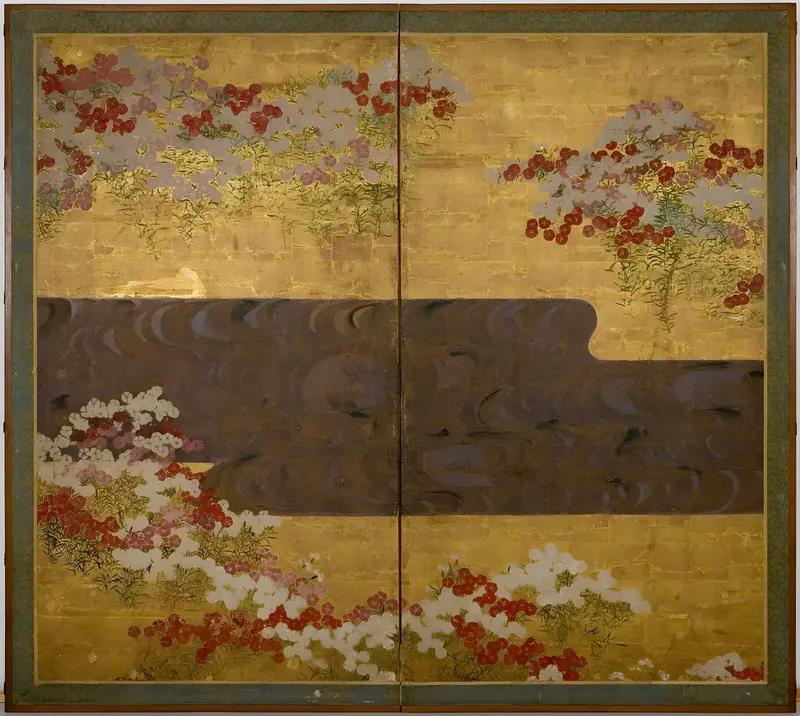
Red and White Plum Blossoms is a pair of two-panel folding screens created by Ogata Kōrin in the 18th century, dated to between 1700 and 1800. This work is executed in color on gold-leafed paper, a hallmark of the Rinpa school with which Kōrin is closely associated. The screens were produced during the Edo period, a time when such decorative panels were highly prized for their use in elite interiors. The composition features two gnarled plum trees, one bearing white blossoms on the left screen and the other red blossoms on the right.
A stylized, swirling river rendered in dark pigments flows diagonally through the golden background, separating the two trees. The gold leaf creates a luminous, reflective surface, while the plum branches are depicted with bold, calligraphic brushwork. The blossoms are sparsely distributed, emphasizing the seasonal motif and the contrast between the two trees. This work is recognized as one of the most celebrated examples of Ogata Kōrin’s screen paintings and is frequently cited as a masterpiece of the Rinpa movement.
It is held today in a major public collection, and its distinctive style has influenced generations of Japanese artists. The screens have been widely exhibited and reproduced, contributing to their status as icons of Japanese art from the Edo period.