
Römische Ruinen mit Tonnengewölbe; die Bäder des Caracalla — History & Facts
Who listens when art speaks of silence? In a world of transience, the ruins stand as solemn witnesses, inviting reflection on what remains when all else fades. Look to the foreground where the decaying arches of the Caracalla baths beckon the viewer with their grandiosity. The muted palette of browns and grays, interspersed with hints of verdant green, evokes a sense of time-worn wisdom. Notice how the light filters through the open archways, casting elongated shadows that dance upon the weathered stone, almost as if the ruins themselves breathe in the quiet of their surroundings. Amidst the monumental structure, the contrast between the vibrant life outside — suggested by the lush foliage — and the stillness within the ruins creates a poignant commentary on the dualities of existence.
The arches, once vibrant with the laughter of bathers, now stand empty, embodying both the glory and decay of an empire. This interplay of light and shadow reinforces the notion of faith in history; it whispers that while the physical structure may erode, the stories it holds remain alive within our collective memory. In 1788, Maximilian von Verschaffelt painted this work as part of his explorations of classical antiquity, reflecting the Enlightenment ideals of reason and beauty. Living in a time when classical themes dominated artistic thought, he sought to encapsulate the enduring nature of these ruins against the backdrop of contemporary European fascination with history.
His meticulous attention to detail reveals a moment where art not only documents but also evokes an unspoken faith in the permanence of beauty, even in silence.
More Artworks by Maximilian von Verschaffelt
Browse all →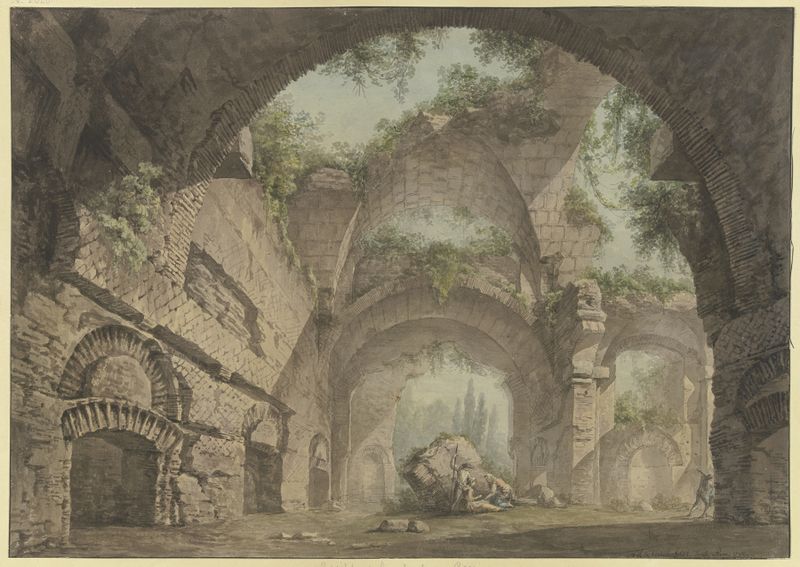
More Architecture Art
Browse all →
The statue of Liberty
Frédéric Auguste Bartholdi

View of Houses in Delft, Known as ‘The Little Street’
Johannes Vermeer

View of Houses in Delft, Known as ‘The Little Street’
Johannes Vermeer

The Cathedral in Rouen. The portal, Grey Weather
Claude Monet

The yellow house
Vincent van Gogh

The Church in Auvers-sur-Oise, View from the Chevet
Vincent van Gogh