
Ruins of the Church of the Holy Sepulchre — History & Facts
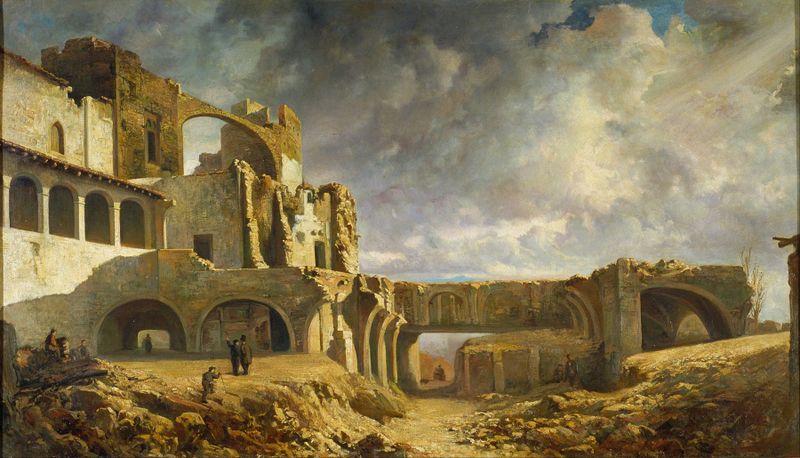
In the delicate interplay of memory and decay, the ruins stand as a testament to desire—an aching longing for what once was. Focus first on the crumbling arches that rise defiantly against the canvas, their noble forms softened by the passage of time. The artist employs a muted palette of earthy tones, allowing shades of ochre and umber to blend harmoniously, evoking a sense of nostalgia. Look closely at the textured surfaces; the interplay of light and shadow reveals forgotten carvings that whisper stories of devotion.
Notice how the faint glow from the sun filters through the broken stone, casting ethereal patterns on the ground—a fleeting moment that enchants the viewer. Hidden beneath the surface of these ruins lies a profound emotional tension. The juxtaposition of strength and fragility is palpable, suggesting that beauty can exist in decay. The scattered remnants speak not only of architectural grandeur but also of the passage of time—each stone cradling memories of joy, suffering, and faith.
This desire to recapture the past mingles with the inevitability of loss, creating a poignant reflection on the transience of human endeavors. In 1862, Ramon Martí i Alsina painted this piece amidst a burgeoning interest in Romanticism and a greater exploration of historical subjects. Working in Barcelona during this dynamic era, he sought to evoke emotional depth through landscapes and ruins, aligning with the movement’s emphasis on individual expression and the sublime in nature. This artwork reflects not just the history of a building but captures the artist’s own relationship with legacy and longing.
More Artworks by Ramon Martí i Alsina
Browse all →
More Architecture Art
Browse all →
The statue of Liberty
Frédéric Auguste Bartholdi

View of Houses in Delft, Known as ‘The Little Street’
Johannes Vermeer

View of Houses in Delft, Known as ‘The Little Street’
Johannes Vermeer

The Cathedral in Rouen. The portal, Grey Weather
Claude Monet

The yellow house
Vincent van Gogh

The Church in Auvers-sur-Oise, View from the Chevet
Vincent van Gogh