
Ruïne van de kerk te Serooskerken — History & Facts
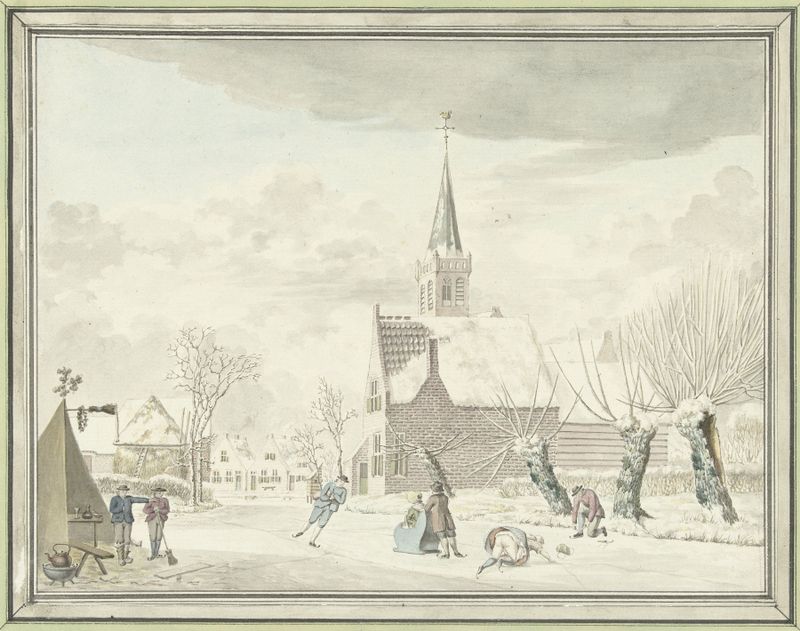
Can paint confess what words never could? In the haunting stillness of Ruïne van de kerk te Serooskerken, truth emerges through the cracks of decay and the whispers of history. Focus on the stark contrast between the crumbling church and the verdant growth that envelopes it. Look to the left at the intricate details of the stonework, where time has etched its inevitable designs, and the light filters softly through gaps, illuminating the struggles of nature reclaiming its domain. The muted palette of earthy tones evokes a somber yet serene nostalgia, drawing the eye toward the foreground's rich greens, which vibrantly pulse against the somber remnants of the past. In this artwork, the artist captures a poignant duality: the church, once a place of refuge and community, now lies in ruins, symbolizing loss and the passage of time.
Yet, amidst the decay, there’s an unwavering presence of life, highlighting resilience and the continuous cycle of renewal. Each weathered stone tells a story, and the gentle encroachment of nature reflects a poignant truth — that beauty often lies in impermanence. Cornelis van Noorde painted this piece during the late 18th century, when the Romantic movement was gaining momentum across Europe. Living in the Netherlands, he was influenced by the rising interest in capturing landscapes with emotional depth and historical context.
This period saw a shift in artistic focus, emphasizing the intersection of nature and architecture, and van Noorde’s work stands as a testament to that evolving vision.
More Artworks by Cornelis van Noorde
Browse all →
More Architecture Art
Browse all →
The statue of Liberty
Frédéric Auguste Bartholdi

View of Houses in Delft, Known as ‘The Little Street’
Johannes Vermeer

View of Houses in Delft, Known as ‘The Little Street’
Johannes Vermeer

The Cathedral in Rouen. The portal, Grey Weather
Claude Monet

The yellow house
Vincent van Gogh

The Church in Auvers-sur-Oise, View from the Chevet
Vincent van Gogh