
Schloß Ambras in Tirol — History & Facts
Who listens when art speaks of silence? In Schloß Ambras in Tirol, the stillness of a frozen moment invites us to ponder the whispers of history and the echoes of revolution. Look to the left of the canvas, where the majestic castle stands resolute against a backdrop of verdant hills. The warm hues of the setting sun cast a golden light across the stone facade, bringing an almost ethereal quality to the structure. Notice how the artist delicately captures the interplay of light and shadow, enhancing the depth of the stone walls while the lush greenery breathes life into the foreground.
The composition balances the grandeur of architecture with the serenity of nature, drawing the eye towards the harmonious coexistence of man and landscape. Hidden within this tranquil scene is a palpable tension. The castle, a symbol of aristocratic power, stands as a sentinel over the unfolding social changes of the time. The vibrant colors evoke both beauty and an underlying unease, reflecting the struggles between tradition and modernity.
One might consider how the very silence of the scene implies a world on the brink of transformation, a moment before the storm of revolution alters the fabric of society forever. Edmund Höd painted this work in 1880 while residing in Austria, a period marked by political unrest and social upheaval across Europe. Influenced by the Romantic movement, he sought to capture the essence of his homeland's landscapes while also nodding to the historical weight they carried. Amidst the shifting tides of art and culture, Höd's canvas serves as a poignant reminder of an era on the cusp of change, inviting viewers to reflect on the dualities of peace and conflict.
More Artworks by Edmund Höd
Browse all →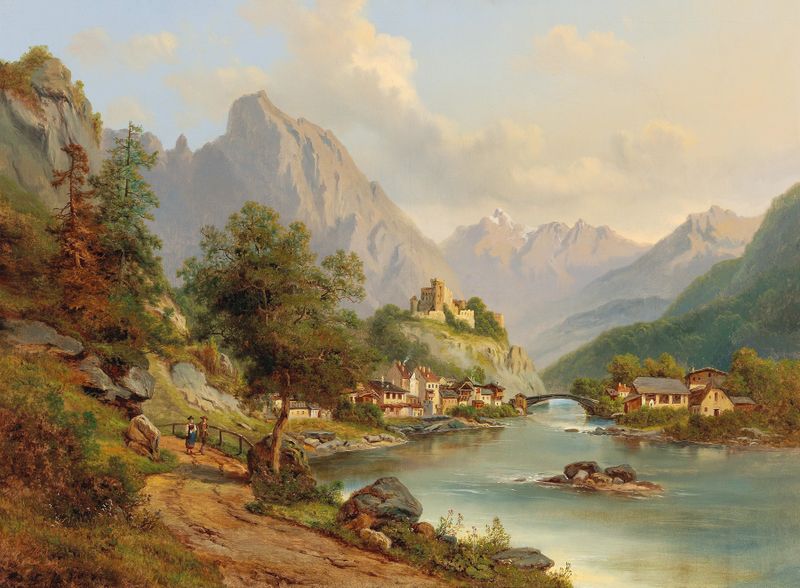

More Architecture Art
Browse all →
The statue of Liberty
Frédéric Auguste Bartholdi

View of Houses in Delft, Known as ‘The Little Street’
Johannes Vermeer

View of Houses in Delft, Known as ‘The Little Street’
Johannes Vermeer

The Cathedral in Rouen. The portal, Grey Weather
Claude Monet

The yellow house
Vincent van Gogh

The Church in Auvers-sur-Oise, View from the Chevet
Vincent van Gogh