
Schweizer Tor in Hofburg residence — History & Facts
When did color learn to lie? In the play of hues and shadows, the essence of reality bends, inviting deeper contemplation on the nature of creation itself. Look to the center of the canvas where the bold strokes converge, forming the magnificent archway of the Schweizer Tor. The soft, warm tones gently blend to create a sense of depth, while cooler shades flank the structure, giving the illusion of space and time beyond it. Notice how the artist employs chiaroscuro to highlight intricate details; the shadows cradle the arch, making it loom larger than life and effortlessly drawing the viewer’s gaze upward. The juxtaposition of light and dark beckons a dialogue between stability and transience.
The archway stands as a symbol of passage, yet it remains static—inviting contemplation on the eternal versus the ephemeral. The way light dances off the surfaces suggests a moment frozen in time, capturing both the grandeur of the architecture and the fragility of human experience. Each brushstroke seems to narrate a silent story, evoking feelings of nostalgia and exploration. Franz Hoffelner created this work during a time when the art world was shifting towards modernism, likely influenced by the transformative energy of early 20th-century Vienna.
Amidst a backdrop of cultural upheaval, he sought to blend tradition with innovation, reflecting the architectural beauty of the Hofburg residence while embracing a new artistic vision. This period in Hoffelner’s life was marked by a search for identity in art, as he approached the canvas with a desire to explore the boundaries of perception and representation.
More Artworks by Franz Hoffelner
Browse all →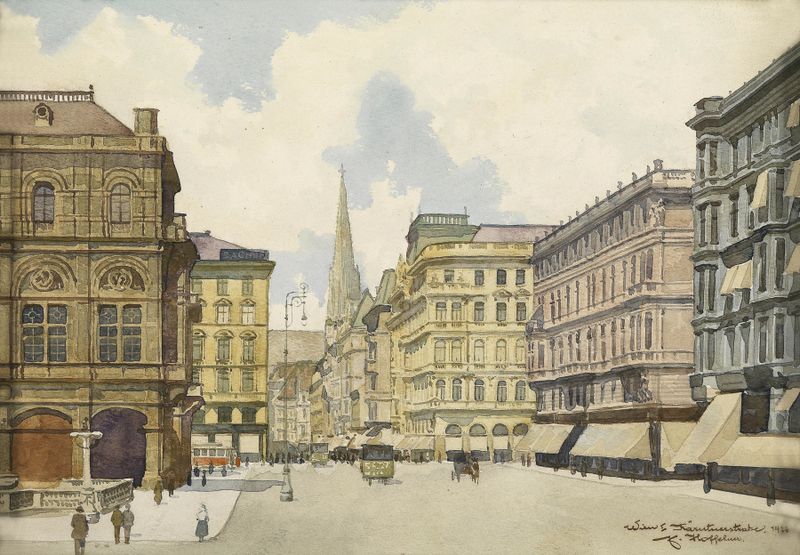

More Architecture Art
Browse all →
The statue of Liberty
Frédéric Auguste Bartholdi

View of Houses in Delft, Known as ‘The Little Street’
Johannes Vermeer

View of Houses in Delft, Known as ‘The Little Street’
Johannes Vermeer

The Cathedral in Rouen. The portal, Grey Weather
Claude Monet

The yellow house
Vincent van Gogh

The Church in Auvers-sur-Oise, View from the Chevet
Vincent van Gogh