Ships on a Stormy Sea — History & Facts
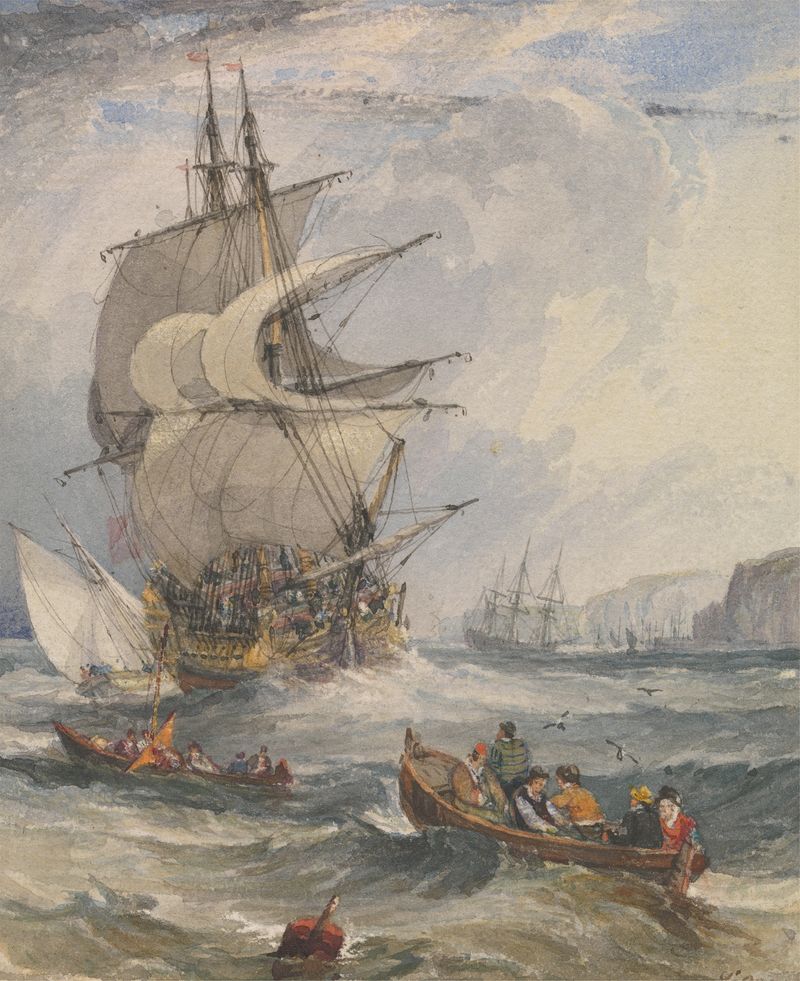
Can beauty exist without sorrow? In Samuel Owen's Ships on a Stormy Sea, desire and despair intertwine, revealing the haunting struggle of mankind against nature's fury. Focus first on the tumultuous waves crashing against the hulls of the ships. The dark, swirling blues and grays dominate the canvas, creating a sense of chaos that draws the eye, while the white foam of the waves contrasts sharply, hinting at the ferocity of the storm. Notice how the flickers of light break through the dark clouds, illuminating the masts and sails, lending a glimmer of hope amidst the turmoil.
The careful brushwork demonstrates both the movement of the sea and the tension within the vessels, capturing a moment of peril as sailors battle against the elements. Delve deeper into the emotional complexities presented in this scene. The juxtaposition of the ships, sturdy yet vulnerable, speaks to humanity's relentless spirit in the face of overwhelming odds. Each ship's struggle against the waves represents a yearning for survival, amplified by the foreboding sky—a reminder that desire often walks hand-in-hand with suffering.
The viewer feels the weight of uncertainty as the winds howl, illustrating the thin line between hope and despair that defines human existence. In 1836, Owen painted this work during a period of great change in maritime exploration and industry, reflecting the anxieties and aspirations of his times. Living in England, he was influenced by the Romantic movement, which emphasized emotion and the sublime power of nature. As tensions rose in the world around him, art became a means to explore the profound relationship between humanity and the elemental forces that shape our lives.