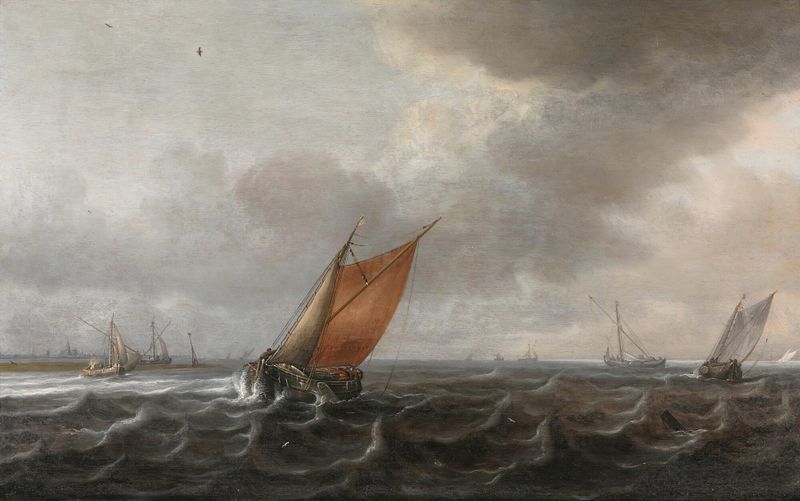
Ships on the Haarlemmermeer with additional vessels in the distance — History & Facts
When did color learn to lie? In the expanse of this work lies a haunting emptiness, a void that speaks as loudly as the vessels scattered across the canvas. The serene yet melancholic atmosphere invites introspection, challenging the viewer to confront the discord between appearance and reality. Focus on the horizon, where muted blues and soft grays blend seamlessly, creating a vast sky that looms over the tranquil waters. Notice how the ships appear like whispers against this backdrop, their delicate forms barely disturbing the surface of the Haarlemmermeer.
The artist's deft brushwork and subtle palette evoke a sense of stillness, yet an underlying tension simmers as the distant vessels beckon with the possibility of unseen journeys. Delve deeper into the painting, and you’ll find contrasts woven into its fabric—between the solidity of the ships and the ephemeral nature of the atmosphere, between the promise of adventure and the stillness of the water. The empty spaces are not mere absences; they are pregnant with meaning, evoking feelings of isolation and longing. Each vessel seems to float in a world both complete and incomplete, stirring questions about place, purpose, and the passage of time. During an uncertain period in his life, Justus de Verwer painted this piece, likely in the early 17th century.
As a Dutch artist, he was immersed in a rapidly evolving art scene, one that pivoted from religious themes to the exploration of landscapes and maritime subjects. This shift mirrored societal changes, revealing an emerging relationship between man and nature—one that resonates through the emptiness captured in this work.