Southern Landscape with an Aqueduct — History & Facts
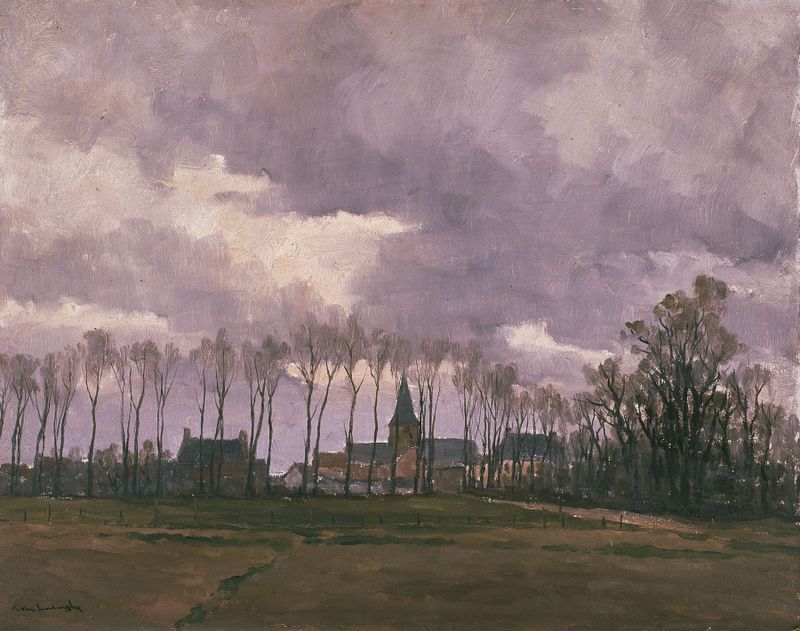
Where does light end, and longing begin? In the realm of the sublime, Karel Van Lerberghe’s work invites us to ponder divinity through an enchanting interplay of nature and architecture. Focus first on the serene aqueduct, which elegantly cuts across the canvas. Its muted tones of ochre and gray juxtapose the lush greens and blues of the surrounding landscape, drawing the eye along its curved lines. The gentle play of sunlight filtering through the clouds creates a soft glow that dances upon the water’s surface, suggesting a transcendent quality.
Look closely at the interplay of shadows cast by the aqueduct—each detail signifies the passage of time, while the expansive horizon hints at endless possibilities. Beyond its surface beauty, the painting evokes emotional contrasts between the man-made and the organic. The aqueduct, symbolizing human ingenuity, stands solid against the fluidity of nature. Yet, there’s a sense of nostalgia—an invitation to reflect on the relationship between humanity and the divine, where the structure might represent both a bridge and a barrier to the spiritual realm.
The tranquility of the scene speaks of longing and contemplation, urging viewers to explore the intersection of earthly life and celestial aspirations. In the early 20th century, while Van Lerberghe captured Southern Landscape with an Aqueduct, he was immersed in the Symbolist movement, which sought to express the spiritual through art. Living in Belgium, he drew from the rich natural beauty of his surroundings, seeking to convey deeper meanings through landscape. This period marked a transition in the art world, where the emphasis on individual perception and emotion began to redefine artistic expression, and Van Lerberghe was at the forefront of this evolution.