Spring or The month of March — History & Facts
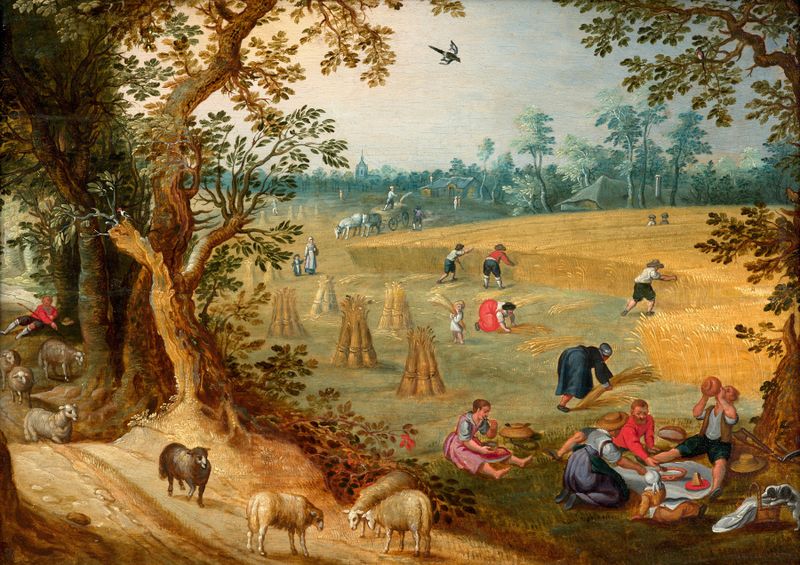
Is this a mirror — or a memory? Innocence blooms in every corner of Spring or The month of March, inviting the viewer to ponder the nuances of youth and the fleeting nature of time. Look to the vibrant greens and soft blues that dominate the landscape, drawing your eye toward the horizon where life awakens. Notice how the delicate brushstrokes render each flower with care, their petals seeming to flutter in the breeze. The figures scattered throughout the scene — children playing, adults tending to the earth — are imbued with gentle motion, embodying the essence of rebirth and joy.
The use of light is remarkable; it dances across the canvas, illuminating the innocence etched in every face, while casting soft shadows that suggest the passage of time. Yet, beneath this idyllic surface, a hint of tension lingers. The contrast between the youthful exuberance of the children and the watchful eyes of the adults suggests a duality — the carefree nature of youth juxtaposed with the weight of responsibility that looms ahead. Each detail, from the expression of a child lost in play to the furrowed brow of a caretaker, speaks of the inevitable march toward maturity.
The golden light of spring brings warmth, but also a sense of impermanence, reminding us that innocence is as transient as the seasons. Sebastien Vrancx created this enchanting piece during a time when the Flemish Baroque style was being explored and established in the early 17th century. Working in Antwerp, he was influenced by both local and Italian artists, striving for a balance between realism and idealization. This artwork reflects not only his personal exploration but also the broader cultural transition, as society began to value the themes of everyday life and the beauty found in simplicity.