Strand — History & Facts
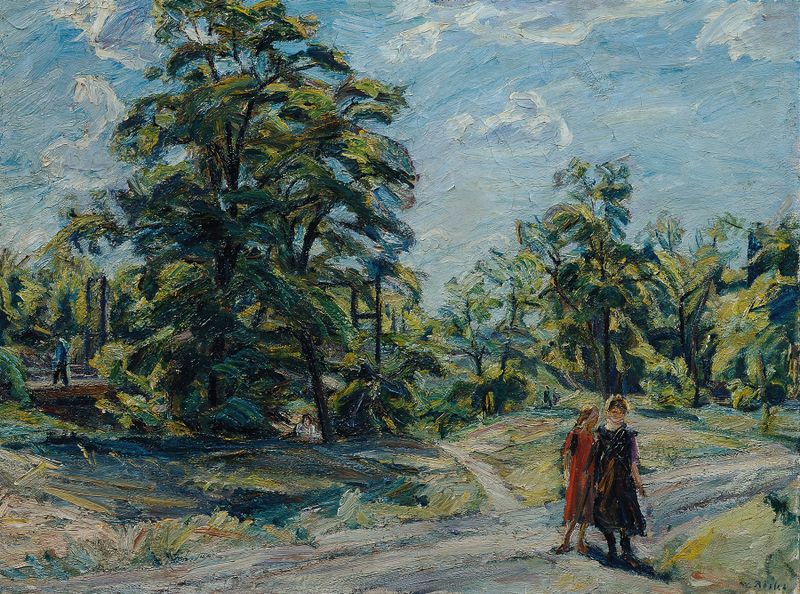
Can beauty exist without sorrow? This question lingers in the air like a fleeting shadow, echoing the yearning found within Waldemar Rösler's Strand. Look to the foreground, where the gentle curves of the sandy beach meet the rhythmic push and pull of turbulent waves. The colors are muted yet poignant; soft beiges and grays create a melancholic ambiance, while fleeting glimmers of sunlight dance on the water's surface, hinting at warmth amid the chill. The composition draws your eye toward the horizon, where the sky melts into a gradient of blues, suggesting both distance and longing. As you explore further, notice the solitary figures meandering along the shoreline, their postures imbued with an ineffable sense of isolation.
This contrast between the vast openness of the landscape and the fragile presence of humanity evokes a deep tension, encapsulating the struggle between solitude and connection. The delicate brushwork reveals the artist's emotional depth, as if each stroke carries whispered secrets of hope and despair. Created between 1912 and 1914, Strand emerged during a pivotal period in Rösler's life, marked by personal loss and the burgeoning art movements of the time. Living in Poland, he was influenced by the shift towards modernism, reflecting both the beauty of nature and the complexities of human emotion.
This work stands as a testament to the artist's exploration of existential themes, resonating with a world on the brink of change.