
The Aqueduct at Rio de Janeiro — History & Facts
Each stroke captures the delicate balance between the grandeur of human achievement and the fleeting nature of existence. Mortality whispers through the arches of the aqueduct, reminding us that even monumental structures are destined to succumb to time. Focus your gaze on the robust, painted arches that dominate the foreground—they stand resolute against a backdrop of lush green hills. Notice how the light dances across the stonework, revealing textures that resonate with history.
The palette of muted earth tones merges harmoniously with splashes of vibrant color, suggesting life teeming in the shadow of the aqueduct. The composition leads your eye along the curve of the structure, inviting you to explore the relationship between nature and human endeavor. Yet, amidst the strength of the aqueduct, there lies an undercurrent of transience. The gentle ripples of the water below reflect not just the sky but also the passage of time, evoking the inevitability of decay.
Look closely at the figures flitting in the distance; their smallness against the grandeur of the architecture emphasizes humanity’s humble place in the face of monumental achievements. This tension between permanence and the ephemeral breathes life into the piece, urging contemplation of what endures and what fades. Nicolas-Antoine Taunay painted this work between 1816 and 1817, during a period marked by the rise of Romanticism and a growing fascination with the sublime in nature and architecture. Creating it in Brazil, Taunay reflected on the country's emerging identity, shaped by colonial history and the complex relationship between civilization and the wilderness.
As he captured this iconic aqueduct, he was also engaging with broader themes of mortality and legacy, framing the conversation of an era ripe for reflection and transformation.
More Artworks by Nicolas-Antoine Taunay
Browse all →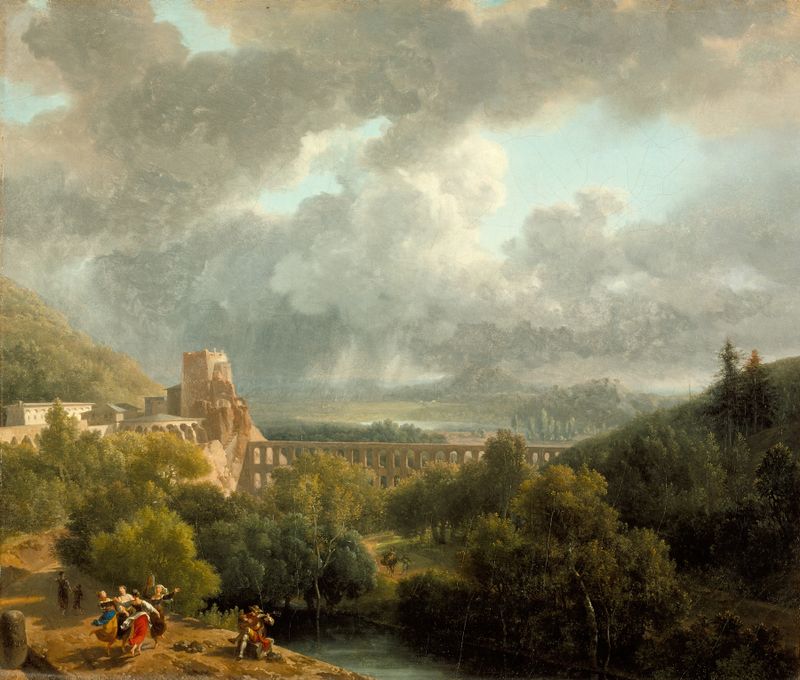
More Architecture Art
Browse all →
The statue of Liberty
Frédéric Auguste Bartholdi

View of Houses in Delft, Known as ‘The Little Street’
Johannes Vermeer

View of Houses in Delft, Known as ‘The Little Street’
Johannes Vermeer

The Cathedral in Rouen. The portal, Grey Weather
Claude Monet

The yellow house
Vincent van Gogh

The Church in Auvers-sur-Oise, View from the Chevet
Vincent van Gogh