
The Church of San Trovaso, Venice — History & Facts
Is this a mirror — or a memory? The delicate balance between the past and present is palpable in the tranquil depiction of Venice’s Church of San Trovaso, where time seems to pause in reverence. Focus first on the serene waterway reflecting the church’s façade, which draws the viewer's eye immediately to its arching windows. Notice the soft hues of blue and green that envelop the scene, evoking a tranquil atmosphere. The gentle brushstrokes guide us through the intricate details of the architecture, while dappled sunlight plays upon the surface of the water, creating an illusion of depth and movement.
In this harmony of color and form, Joyant captures both the solidity of the church and the ephemeral nature of light. Delving deeper, the painting suggests a dialogue between permanence and transience. The solid structure stands firm against the backdrop of wispy clouds, symbolizing the enduring nature of faith amidst life's fleeting moments. Additionally, the contrast of vibrant colors against the muted tones of the surrounding landscape evokes an emotional tension, highlighting the balance between the vibrancy of life and the stillness of reflection.
Each element serves to remind us of both the beauty and fragility inherent in our experiences. In 1830, while residing in Venice, the artist created this piece during a time of artistic exploration and innovation in Europe. The Romantic movement was flourishing, emphasizing emotion and the sublime, and Joyant, influenced by this context, sought to capture the ethereal qualities of Venetian light and the spiritual resonance of its architecture. This work stands as a testament to his dedication to merging the visual with the emotional, embodying a moment of clarity within the rich tapestry of the city’s history.
More Artworks by Jules-Romain Joyant
Browse all →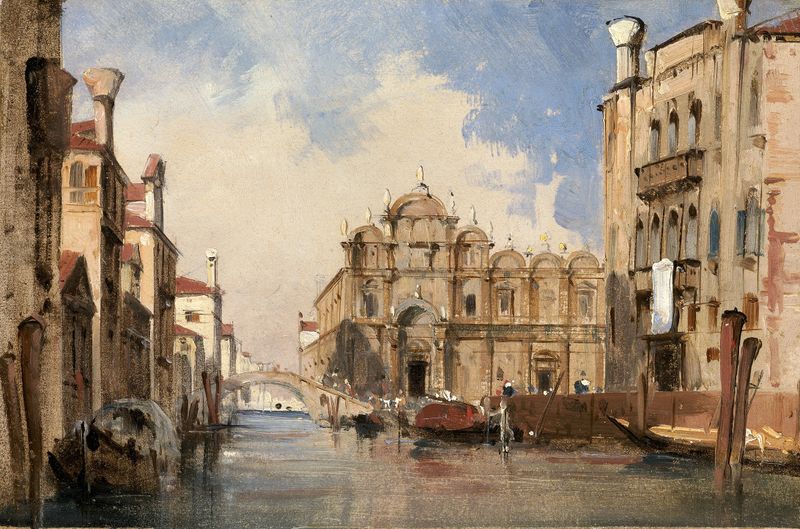
More Architecture Art
Browse all →
The statue of Liberty
Frédéric Auguste Bartholdi

View of Houses in Delft, Known as ‘The Little Street’
Johannes Vermeer

View of Houses in Delft, Known as ‘The Little Street’
Johannes Vermeer

The Cathedral in Rouen. The portal, Grey Weather
Claude Monet

The yellow house
Vincent van Gogh

The Church in Auvers-sur-Oise, View from the Chevet
Vincent van Gogh