
The landing place to a Temple of Victory through the Gate of Minerva — History & Facts
Who listens when art speaks of silence? In The landing place to a Temple of Victory through the Gate of Minerva, faith becomes a whisper that echoes through time, inviting us to engage with the unseen. Look to the foreground, where the grand gate stands tall, intricately adorned, beckoning viewers with its classical beauty. The light cascades softly over the stone, illuminating the finely etched details that mirror the ancient ideals of strength and victory. The careful orchestration of warm and cool tones creates a balance between shadow and illumination, echoing the dualities of hope and despair inherent in our pursuit of triumph. As you delve deeper into the scene, note the juxtaposition of the serene sky against the imposing architecture.
Each element—be it the stillness of the figures or the weight of the monumental gate—evokes a sense of reverence and contemplation. This quiet tension speaks of aspirations, symbolizing not just a physical entrance but a spiritual journey toward enlightenment, where faith intertwines with the quest for glory. Joseph Michael Gandy painted this work during a period when neoclassicism was at its zenith, around the turn of the 19th century. Embraced by the Romantic movement yet firmly rooted in classical ideals, he sought to elevate architectural forms to a spiritual realm.
In a time of political upheaval and shifting artistic landscapes, Gandy’s vision reflects a longing for stability and transcendence amidst chaos, capturing the essence of a society grappling with its identity.
More Artworks by Joseph Michael Gandy
Browse all →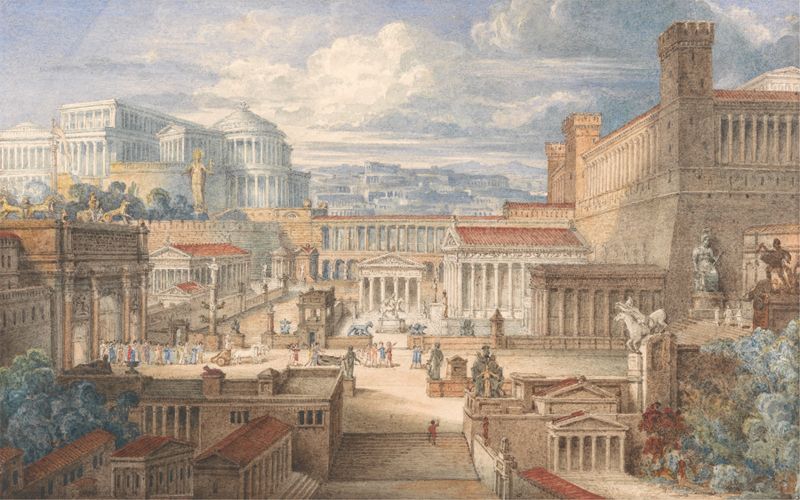
More Architecture Art
Browse all →
The statue of Liberty
Frédéric Auguste Bartholdi

View of Houses in Delft, Known as ‘The Little Street’
Johannes Vermeer

View of Houses in Delft, Known as ‘The Little Street’
Johannes Vermeer

The Cathedral in Rouen. The portal, Grey Weather
Claude Monet

The yellow house
Vincent van Gogh

The Church in Auvers-sur-Oise, View from the Chevet
Vincent van Gogh