The Moorhen’s Haunt — History & Facts
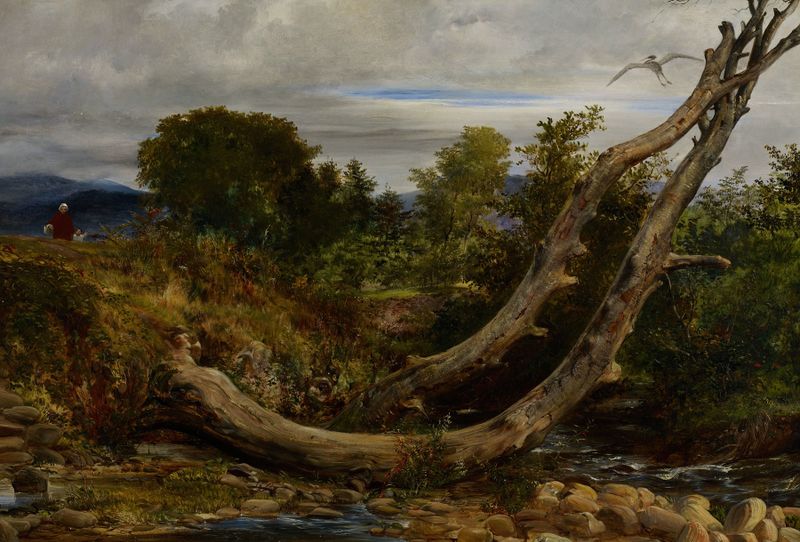
Who listens when art speaks of silence? In The Moorhen’s Haunt, Richard Redgrave captures a moment that resonates with nostalgia, evoking memories of tranquil, forgotten places. Look to the left at the delicate silhouettes of reeds, their slender forms swaying gently against the backdrop of a muted sky. The composition invites the viewer’s eye to dance across the canvas, where a still pond reflects a tapestry of soft earth tones and the subtle play of light. Redgrave’s meticulous brushwork creates a sense of depth, inviting one to linger in the serenity of the scene. As you immerse yourself in the painting, notice the contrast between the vibrant greens and the somber browns, illustrating the delicate balance of life in nature.
The absence of the moorhen, despite its haunting presence in the title, speaks volumes about loss and absence, suggesting a longing for what once was. Each brushstroke tells a story of quietude, where the stillness between the elements becomes a meditation on memory and time's passage. Richard Redgrave painted The Moorhen’s Haunt during a period when he was deeply engaged with nature, a theme prevalent throughout his career. The painting likely emerged in the mid-19th century, a time marked by the burgeoning Romantic movement, which influenced artists to explore emotion, beauty, and the natural world.
As industrialization began to reshape society, Redgrave’s work served as a poignant reminder of the solace found within untouched landscapes, reflecting both personal and collective nostalgia.