The Newa at St Petersburg (Leningrad) in the Winter — History & Facts
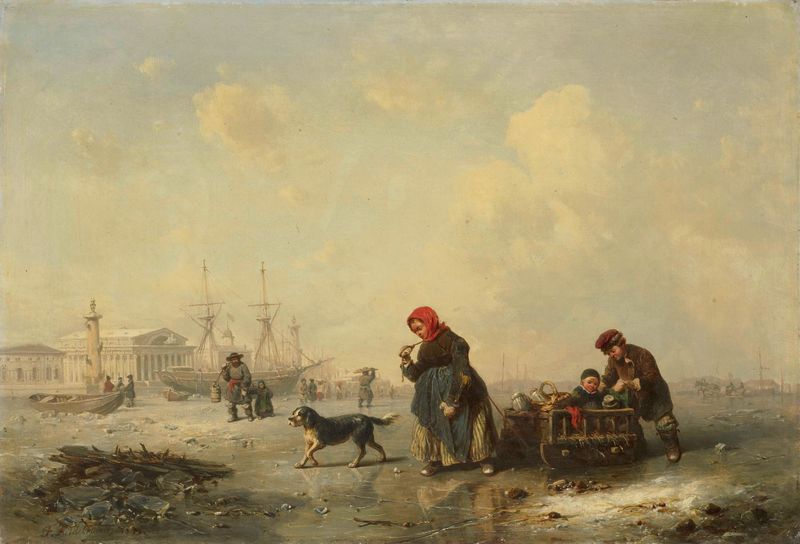
In a landscape where reality and illusion intertwine, a frozen river beckons contemplation, inviting us to explore the deeper mysteries of existence. Look to the center of the composition, where the Newa River flows, now a glistening expanse of ice under the weight of winter’s embrace. The artist captures a delicate balance of light and shadow, the pale sky blending seamlessly with the soft white of the snow. Notice how the faint blush of sunset casts an ethereal glow, illuminating the distant buildings and framing the scene with a sense of both tranquility and isolation.
Each brushstroke adds to the illusion of depth, drawing the viewer into a frozen moment that feels both intimate and expansive. In this work, a tension arises between the starkness of winter and the warmth of human presence, subtly hinted at by the tiny figures in the distance. The contrast of the vibrant hues of the buildings against the muted whites and grays of the snow evokes a longing for connection amidst a harsh landscape. The reflections on the icy surface allude to the fleeting nature of beauty, suggesting that even in the coldest moments, life’s essence remains vibrant and alive, oscillating between reality and the dreamlike semblance of winter. Created in 1844 while the artist was in St.
Petersburg, this period marked a time of great transformation in Russian society and art. Hildebrandt, influenced by the burgeoning Romantic movement, sought to capture the sublime beauty of his surroundings amidst the changing tides of history. The work stands as both a personal reflection and a broader commentary on the interplay of nature and human experience during a tumultuous era.