
The Pantheon — History & Facts
Can paint confess what words never could? In the depths of artistic creation, there lies a language all its own, whispering truths to the heart. Focus your gaze on the majestic dome at the center, where light spills through the oculus, illuminating the space with an ethereal glow. The artist employs a rich palette of earthy tones, blending shadow and light to create depth. Notice how the arches of the colonnade curve gracefully, drawing the viewer’s eye toward the sacred altar, suggesting a journey not just through architecture but through time and spirit. Beneath the grandeur, subtle contrasts emerge.
The interplay of light and dark hints at the eternal struggle between the divine and the mortal realm. The quiet figures, almost ghost-like, are caught in reverence, evoking a sense of timelessness and connection to something greater. Each brushstroke reverberates with the energy of creation, hinting at the artist’s profound contemplation of existence and the sacred space we inhabit. In an undetermined period, Giacomo van Lint painted this captivating work, likely when he was exploring the influences of Baroque architecture intertwined with his own interpretations of classical themes.
During this time, artistic discourse was rich, as artists grappled with the fusion of realism and spirituality, seeking to convey the ineffable through their craft. This piece embodies that quest, bridging the tangible and the transcendental in a masterful dialogue of form and emotion.
More Artworks by Giacomo van Lint
Browse all →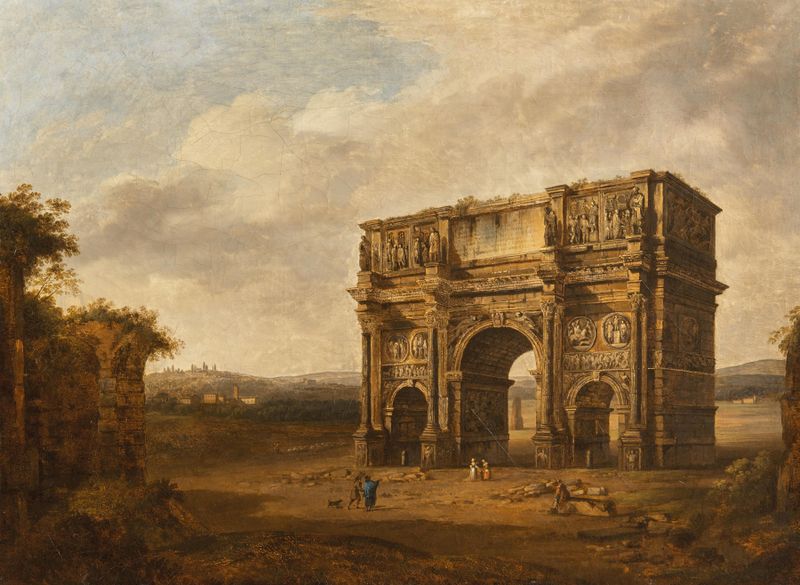
More Architecture Art
Browse all →
The statue of Liberty
Frédéric Auguste Bartholdi

View of Houses in Delft, Known as ‘The Little Street’
Johannes Vermeer

View of Houses in Delft, Known as ‘The Little Street’
Johannes Vermeer

The Cathedral in Rouen. The portal, Grey Weather
Claude Monet

The yellow house
Vincent van Gogh

The Church in Auvers-sur-Oise, View from the Chevet
Vincent van Gogh